

Ligament injuries are among the most common and frustrating musculoskeletal problems, affecting everyone from weekend hikers to elite athletes. Sprains that fail to heal fully can lead to chronic joint instability, persistent pain, and a slow decline in quality of life. Prolotherapy is a non-surgical regenerative injection therapy that stimulates your body's own healing response to repair damaged connective tissue. In this article, we break down the seven primary benefits of prolotherapy for ligament injuries and explain why this treatment has gained recognition as a powerful alternative to surgery and long-term medication use.
What Is Prolotherapy?
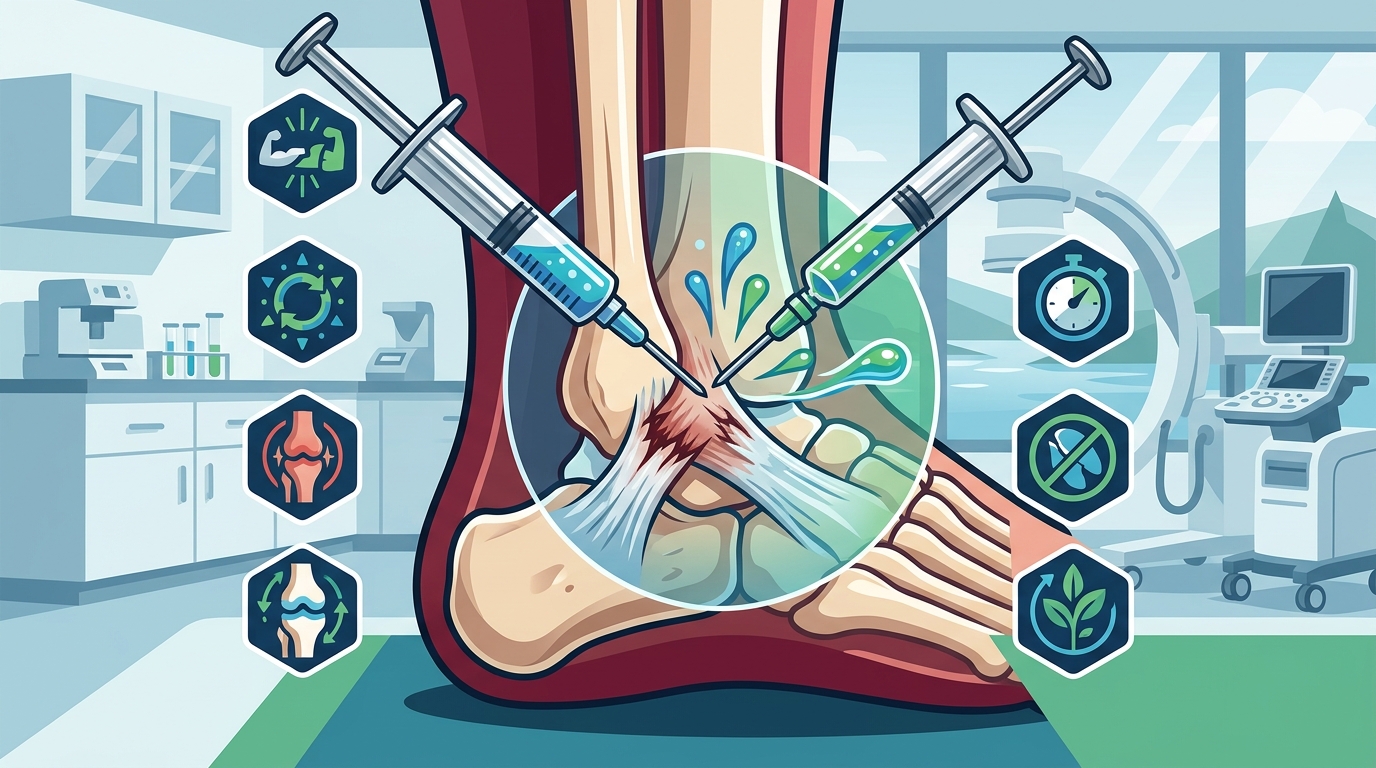
Prolotherapy, short for "proliferative therapy," is a regenerative injection procedure that promotes the repair of damaged connective tissue. A solution of dextrose (a form of glucose) and local anesthetic is injected directly into injured ligaments or tendons. The solution triggers a controlled inflammatory cascade that recruits the body's repair cells to strengthen and rebuild the treated area.
The technique has been used clinically since the 1930s and continues to evolve. According to a clinical trials review on ClinicalTrials.gov, the literature supports prolotherapy as a promising treatment for chronic pain conditions involving tendons, ligaments, and joints.
Benefit 1: Stimulates Natural Tissue Repair
The core mechanism of prolotherapy is its ability to restart your body's innate healing processes. The dextrose solution creates an osmotic effect at the injection site, placing tissue in an injury-like state that initiates a wound repair cascade. Cells infiltrate the area, release chemical messengers, and rebuild damaged collagen over roughly six weeks.
Histological studies confirm that the result is stronger, thicker ligament attachments at the enthesis, which is the point where ligaments and tendons anchor to bone. This biological repair addresses the root cause of injury rather than masking symptoms.
Benefit 2: Restores Joint Stability
When ligaments are injured, the joint they support becomes unstable. Nerves within the ligaments send reflex signals that cause surrounding muscles to spasm in an attempt to compensate. Prolotherapy strengthens weakened ligaments, providing better mechanical support and allowing overworked muscles to finally relax.
A prospective study on ACL laxity found that dextrose prolotherapy reduced anterior displacement and improved knee stability in patients with documented ligament laxity. Restoring stability is essential for preventing re-injury and long-term joint degeneration.
Benefit 3: Reduces Chronic Pain at the Source
Ligament referral pain is a pattern where damaged connective tissue sends pain signals that can mimic nerve compression and lead to misdiagnosis. Unlike pain medications that only block signals, prolotherapy repairs the tissue generating those signals. As Medical News Today explains, once the joint is better supported by strengthened ligaments, the pain can disappear entirely.
Clinical evidence from prolotherapy injections reviewed from 1990 to 2016 showed significant reductions in patient-reported pain across multiple conditions. Many patients at Oregon Regenerative Medicine report meaningful improvement within two to three treatment sessions.
Benefit 4: Non-Surgical with Minimal Downtime
Prolotherapy is a non-surgical, outpatient procedure. Prolotherapy is also known as non-surgical ligament and tendon reconstruction. Most sessions take under an hour, and patients typically return to normal activities within days. By contrast, surgical ligament repair often requires months of rehabilitation and carries risks of complications.
For athletes and active individuals, this means less time away from training and competition. At Oregon Regenerative Medicine, procedures are performed with ultrasound and fluoroscopic guidance for precision and safety.
Benefit 5: Avoids Long-Term Medication Dependence
Long-term use of anti-inflammatory drugs like ibuprofen and naproxen can mask symptoms without healing the underlying tissue. Repeated cortisone injections can actually weaken tendons and ligaments over time. Prolotherapy takes the opposite approach: it contains safe, natural ingredients and works to restore normal tissue strength and elasticity.
Many patients who complete a prolotherapy treatment series are able to eliminate their need for pain medications entirely. This is especially important for patients seeking drug-free solutions to chronic ligament pain.
Benefit 6: Treats a Wide Range of Ligament Injuries
Prolotherapy is effective for Grade I (overstretching) and Grade II (partial tear) ligament sprains throughout the body. Common applications include ACL and MCL injuries, ankle sprains, sacroiliac ligament sprains, rotator cuff injuries, and wrist instability.
| Factor | Prolotherapy | Cortisone Injections | Surgery | Physical Therapy Alone |
|---|---|---|---|---|
| Mechanism | Stimulates tissue repair | Suppresses inflammation | Mechanical reconstruction | Strengthens muscles around joint |
| Addresses root cause | Yes | No | Yes | Partially |
| Downtime | Days | Minimal | Weeks to months | None |
| Risk of tissue weakening | None | Yes (with repeated use) | Low | None |
| Typical sessions needed | 3 to 6 | Limited (max 3 to 4/year) | 1 (plus rehab) | 8 to 12+ |
| Suitable for chronic injuries | Yes | Short-term only | Case-dependent | Yes |
Benefit 7: Combines with PRP and Stem Cell Therapies
Prolotherapy serves as a foundational treatment that can be enhanced with advanced biologics. Platelet Rich Plasma (PRP) is a concentrated preparation of your own platelets containing hundreds of growth factors that accelerate tissue repair. When added to prolotherapy, PRP delivers powerful regenerative signals directly to injured ligaments.
For more advanced degeneration, adipose-derived stem cell therapy can further amplify healing. Oregon Regenerative Medicine prepares PRP, PRF, M-FAT, A2M, and platelet lysates in their in-house laboratory, ensuring quality control and customized treatment for each patient.
Key Takeaways
- Prolotherapy is a non-surgical injection therapy that stimulates your body's natural healing response to repair damaged ligaments.
- It restores joint stability by strengthening weakened connective tissue at its attachment points.
- The treatment addresses the root cause of chronic pain rather than masking it with medication.
- Most patients require three to six sessions and experience minimal downtime between treatments.
- Prolotherapy is effective for a wide range of ligament injuries, from ankle sprains to ACL laxity.
- It avoids the tissue-weakening risks associated with repeated cortisone injections.
- PRP and stem cell therapies can be layered on top of prolotherapy for enhanced results in more severe cases.
Frequently Asked Questions
What exactly is prolotherapy?
Prolotherapy is a regenerative injection therapy that uses a dextrose solution to trigger your body's wound repair cascade. The treatment strengthens and repairs damaged ligaments, tendons, and other connective tissues without surgery.
How does prolotherapy help ligament injuries specifically?
Ligaments have limited blood supply and heal slowly on their own. Prolotherapy jumpstarts the inflammatory healing process at the injury site, promoting collagen production and restoring normal ligament strength and elasticity.
Is prolotherapy painful?
The injection area is anesthetized before treatment, but some discomfort during and after the procedure is normal. Most patients tolerate it well, and any soreness typically resolves within a few days.
How many prolotherapy sessions are needed?
Most ligament injuries require three to six treatment sessions spaced several weeks apart. The exact number depends on injury severity and individual healing response.
Can prolotherapy replace surgery for ligament tears?
For Grade I and Grade II sprains, prolotherapy is often a highly effective alternative to surgery. Complete Grade III tears may still require surgical repair, though prolotherapy can support recovery even in some of those cases.
What is the difference between prolotherapy and PRP?
Classic prolotherapy uses a dextrose solution to initiate healing, while PRP uses concentrated platelets from your own blood to deliver growth factors. The two are often combined for enhanced results.
Are there side effects of prolotherapy?
Prolotherapy is generally considered safe. Common side effects include temporary soreness, swelling, and stiffness at the injection site. Serious complications are rare, especially when performed by experienced practitioners using image guidance.
Does insurance cover prolotherapy?
Most insurance plans do not currently cover prolotherapy, as it is considered an elective regenerative procedure. Contact your provider and clinic directly for specific cost information.
Ready to Heal Your Ligament Injury Without Surgery?
If you are living with chronic ligament pain or joint instability, prolotherapy may be the solution you have been looking for. Oregon Regenerative Medicine has performed over 40,000 regenerative injections since 1978, serving patients throughout Oregon, Washington, and the greater Portland region. Dr. Noel Peterson and the ORM team use ultrasound and fluoroscopic guidance to deliver precise, effective treatment. Call (503) 636-2734 or visit oregenmed.com to schedule your consultation today.