
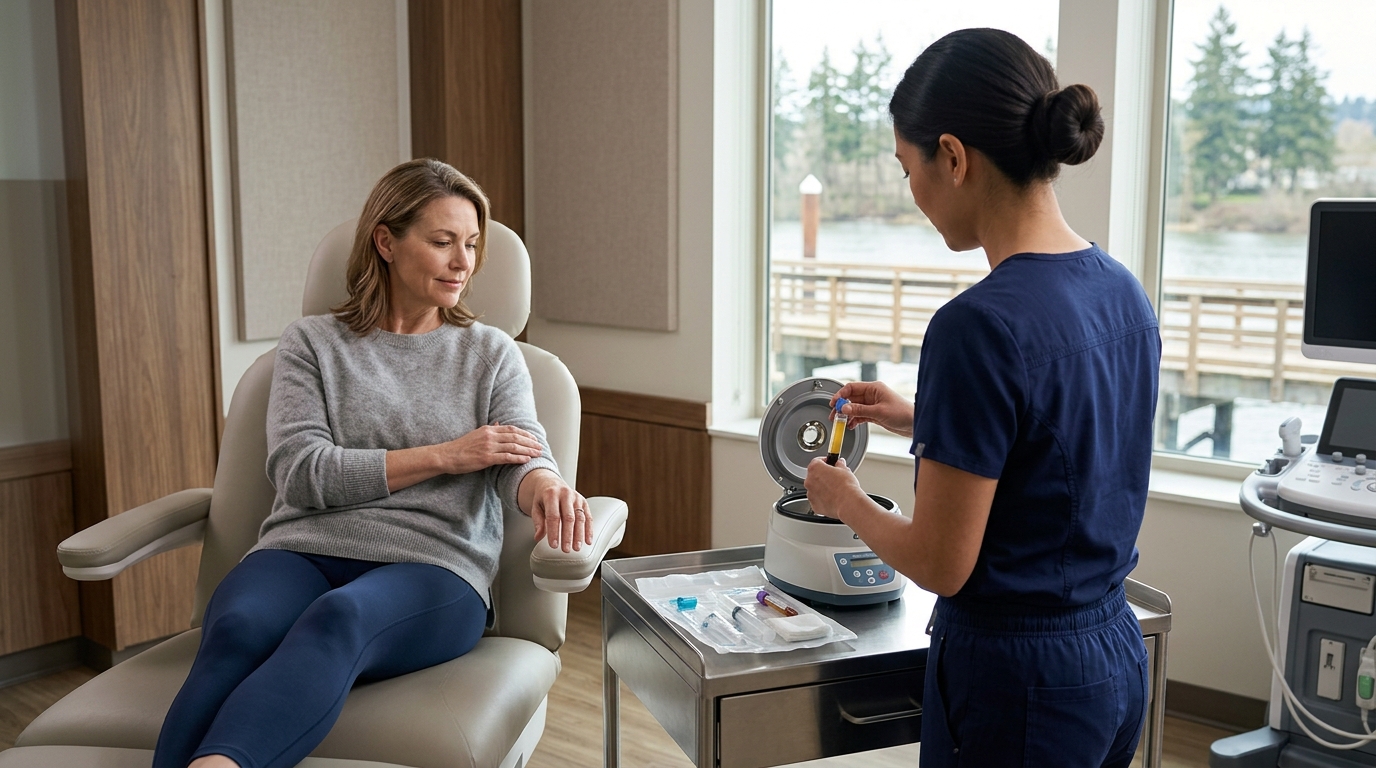
Chronic joint pain affects tens of millions of Americans, and many patients are told their only options are surgery or a lifetime on pain medications. Platelet rich plasma (PRP) therapy offers a different path. PRP is a regenerative injection therapy that uses concentrated growth factors from your own blood to stimulate tissue repair, reduce inflammation, and restore function in damaged joints. In this guide, we break down the science behind PRP, review the latest clinical evidence, and explain what to expect from treatment at a leading regenerative medicine clinic in the Pacific Northwest.
What Is Platelet Rich Plasma?
Platelet rich plasma (PRP) is an autologous biologic therapy, meaning it is derived entirely from your own blood. PRP is defined as a preparation containing one million platelets per microliter in a small volume of plasma, with a full complement of growth and repair factors. Your blood is drawn, processed in a laboratory centrifuge, and the resulting concentrate is injected directly into the injured area.
Within platelets are tiny alpha granules that release over 100 different cell-signaling molecules, including transforming growth factor beta (TGF-B1), vascular endothelial growth factor (VEGF), and platelet-derived growth factor (PDGF). Over 250 signaling molecules have been identified in platelets, making PRP one of the most potent natural stimulants of tissue repair available today.
How PRP Helps Chronic Joint Pain
The healing cascade is the body's organized process of regeneration and remodeling of damaged cells after injury. In chronic joint conditions, this cascade has stalled or become insufficient. PRP reactivates tissue repair cycles by flooding the injury site with concentrated growth factors.
Growth Factor Delivery
When injected, PRP releases growth factors that recruit stem cells, stimulate collagen production, and promote new blood vessel formation. Studies show that PRP induces the production of new collagen by fibroblasts, bone, and cartilage cells at the injection site, rebuilding joint cartilage and strengthening injured ligaments and tendons.

Anti-Inflammatory Effects
PRP also modulates the inflammatory environment inside a joint. By downregulating pro-inflammatory cytokines and promoting anti-inflammatory signaling, PRP helps break the cycle of chronic inflammation that drives osteoarthritis pain.
Cartilage Repair
PRP stimulates chondrocyte repair, cartilage proliferation, and matrix biosynthesis. This new collagen is naturally incorporated into your existing cartilage and ligaments, making them thicker, stronger, and more elastic.
Clinical Evidence: What the Research Shows
A growing body of peer-reviewed research supports PRP for chronic joint pain. A 2025 narrative review in the Journal of Clinical Medicine synthesizing 40 high-quality studies found that PRP injections demonstrate superior pain relief and functional improvement compared to hyaluronic acid and corticosteroids, especially in patients with mild to moderate knee osteoarthritis.
A 2025 systematic review and meta-analysis in Pain and Therapy analyzed randomized controlled trials of PRP for chronic noncancer pain and confirmed analgesic benefits persisting beyond three months compared to both placebo and active treatments. Additionally, a 2025 retrospective study published in Frontiers in Physiology found that repeated PRP injections were about four times more effective than a single injection in reducing pain.
| Study (Year) | Design | Key Finding |
|---|---|---|
| Glinkowski et al. (2025) | Narrative review, 40 studies | PRP superior to HA and corticosteroids for mild-moderate knee OA |
| Wang et al. (2025) | Systematic review & meta-analysis of RCTs | PRP provides sustained pain relief beyond 3 months |
| Yi et al. (2025) | Overview of systematic reviews | PRP improves pain and function in knee OA |
| West China Hospital (2025) | Retrospective cohort | Repeated PRP injections 4x more effective than single injection |
Conditions Treated with PRP
PRP therapy is used to treat a wide range of musculoskeletal conditions. At Oregon Regenerative Medicine, regenerative injections address both acute injuries and chronic degenerative conditions, including:
- Osteoarthritis of the knee, hip, shoulder, and spine
- Rotator cuff tears and tendinopathy
- ACL injuries and meniscus tears
- Chronic back and neck pain
- Tennis and golfer's elbow
- Plantar fasciitis
- Sacroiliac joint dysfunction
PRP has been found to be effective in over 80% of acute and chronic sports and accidental injuries treated at Oregon Regenerative Medicine, with Dr. Noel Peterson applying more than 15 years of clinical PRP experience to each case.
PRP vs. Cortisone, Hyaluronic Acid, and Surgery
Cortisone injections are a short-term anti-inflammatory solution that can actually accelerate cartilage breakdown over time. Hyaluronic acid (HA) provides lubrication but does not stimulate tissue repair. PRP, by contrast, addresses the underlying biology of joint degeneration.
| Factor | Cortisone | Hyaluronic Acid | PRP |
|---|---|---|---|
| Mechanism | Suppresses inflammation | Joint lubrication | Stimulates tissue regeneration |
| Duration of relief | Weeks to months | Months | 6-12+ months |
| Cartilage effect | May accelerate loss | Neutral | Promotes repair |
| Source | Synthetic drug | Synthetic or animal-derived | Autologous (your own blood) |
| Long-term safety | Limited repeat use | Generally safe | Excellent safety profile |
For patients with more advanced degeneration, adipose-derived stem cell therapy can be combined with PRP for enhanced results. Stem cells, when combined with platelet rich plasma, offer the best alternative to hip and knee joint replacement for appropriate candidates.
What to Expect During PRP Treatment
A thorough evaluation comes first. At Oregon Regenerative Medicine, the clinical team provides a complete history, physical exam, reviews your imaging, and performs diagnostic ultrasound before determining candidacy. Four Sonosite ultrasound systems and a GE OEC One Flat Panel C-Arm enable precise, image-guided injections.
The Procedure
Blood is drawn and processed in the clinic's in-house laboratory to concentrate platelets. The PRP is then injected directly into the affected joint or tissue under ultrasound or fluoroscopic guidance. Most procedures take about one to two hours.
Recovery
Patients can typically remain active during the treatment process. Patients should avoid NSAID use for at least five days prior to PRP treatment, as research shows NSAIDs inhibit the ability of PRP to stimulate tissue repair. Most patients undergo two to four treatment sessions spaced several weeks apart.
Why PRP Preparation Quality Matters
Not all PRP is created equal. PRP preparation quality is the single most important variable determining clinical outcomes. Most positive outcome studies support a platelet concentration of four to six times the patient's baseline level.
Oregon Regenerative Medicine is the only Pacific Northwest clinic to analyze every patient's PRP sample in their laboratory before injection, confirming 1 to 2 billion platelets in every milliliter. By contrast, some commercial kits used in published studies have actually produced platelet-poor plasma, yielding no clinical benefit. If a clinic is not testing its PRP concentration, patients have no assurance they are receiving a biologically active product.
Key Takeaways
- PRP is a regenerative therapy that uses your own concentrated platelets to stimulate healing in damaged joints.
- Clinical evidence from multiple 2025 systematic reviews supports PRP over cortisone and hyaluronic acid for chronic joint pain.
- PRP promotes collagen production, cartilage repair, and anti-inflammatory signaling.
- Repeated PRP injections may be up to four times more effective than a single treatment.
- PRP preparation quality varies widely between clinics and directly impacts outcomes.
- Patients should avoid NSAIDs for at least five days before treatment.
- Oregon Regenerative Medicine laboratory-verifies every PRP sample and has performed over 40,000 regenerative injections.
Frequently Asked Questions
What is platelet rich plasma therapy?
Platelet rich plasma therapy is a regenerative injection treatment that concentrates growth factors from your own blood and delivers them directly to injured or degenerated tissues to stimulate natural healing.
How long does PRP take to work for joint pain?
Most patients begin noticing improvement within two to six weeks after treatment. Research shows benefits continue to build over three to twelve months, particularly with repeated injections.
Is PRP therapy safe?
Yes. PRP is autologous, meaning it comes from your own body, which eliminates the risk of allergic reaction or disease transmission. Side effects are typically limited to mild soreness at the injection site.
How many PRP treatments will I need?
Most chronic joint conditions require two to four treatment sessions spaced several weeks apart. Your physician will tailor the protocol based on the severity of your condition and your response to treatment.
Does insurance cover PRP therapy?
Most insurance plans do not currently cover PRP therapy, as it is considered an elective regenerative procedure. However, many patients find the long-term cost savings compared to surgery make PRP a worthwhile investment.
Can PRP help avoid joint replacement surgery?
For many patients with mild to moderate osteoarthritis, PRP can significantly reduce pain and improve function, potentially delaying or eliminating the need for joint replacement. More advanced cases may benefit from combining PRP with adipose stem cell therapy.
What should I avoid before PRP treatment?
Avoid nonsteroidal anti-inflammatory drugs (NSAIDs) such as ibuprofen and naproxen for at least five days before your procedure, as they can impair platelet function and reduce treatment effectiveness.
Where can I get PRP therapy in Portland, Oregon?
Oregon Regenerative Medicine in Lake Oswego has been providing PRP therapy since 2004 and has performed over 40,000 regenerative injections. The clinic offers laboratory-verified PRP, ultrasound-guided and fluoroscopy-guided procedures, and comprehensive regenerative care.
Take the Next Step Toward Pain-Free Living
If chronic joint pain is limiting your life, PRP therapy may offer the relief you have been looking for. Schedule a consultation with Oregon Regenerative Medicine to learn whether PRP is right for your condition. With over 40,000 regenerative injections performed and laboratory-verified PRP quality, the ORM team is dedicated to helping you achieve durable, drug-free results.