
How Regenerative Medicine Injections Promote Natural Joint Healing
Millions of Americans live with chronic joint pain from osteoarthritis, sports injuries, or degenerative conditions. Many are told that surgery or a lifetime on pain medications is their only option. Regenerative medicine injections offer a fundamentally different approach: rather than masking symptoms, they activate your body's own repair mechanisms to restore damaged tendons, ligaments, and joints. From prolotherapy to platelet-rich plasma (PRP) to adipose tissue stem cell grafts, these non-surgical treatments work by restarting the healing cascade at the cellular level. This guide explains the science behind each therapy and what patients should know before choosing a treatment path.
What Is Regenerative Injection Therapy?
Regenerative injection therapy is a category of non-surgical procedures that use biological agents to promote repair of damaged connective tissue. Unlike cortisone shots, which suppress inflammation and can degrade tissue over time, regenerative injections stimulate the inflammatory and immune systems to initiate genuine tissue repair.
The three primary forms of regenerative injection therapy are prolotherapy, platelet-rich plasma (PRP), and adipose tissue stem cell grafts. Each therapy targets a different level of the body's repair system, and they can be used individually or in combination depending on injury severity.
The Healing Cascade: How Your Body Repairs Itself
The healing cascade is the body's organized, multi-phase response to tissue damage. When an injury occurs, your body follows a natural sequence of inflammation, cell recruitment, tissue proliferation, and remodeling. Platelets arrive first, releasing growth factors that signal repair cells to the injury site.
In chronic injuries, this cascade stalls or never fully completes. Regenerative injections work by reactivating this stalled process. According to StatPearls research published on the NCBI Bookshelf, hypertonic dextrose used in prolotherapy induces localized tissue trauma that recruits granulocytes and macrophages to facilitate repair. PRP and stem cell therapies amplify this response with concentrated biological agents.
Prolotherapy: The Foundation of Regenerative Injections
Prolotherapy is short for proliferative therapy and is the most time-tested form of non-surgical regenerative injection. Developed in the 1950s by George Hackett, MD, this technique uses a solution of dextrose (a form of sugar) injected into damaged ligaments, tendons, or joint capsules.
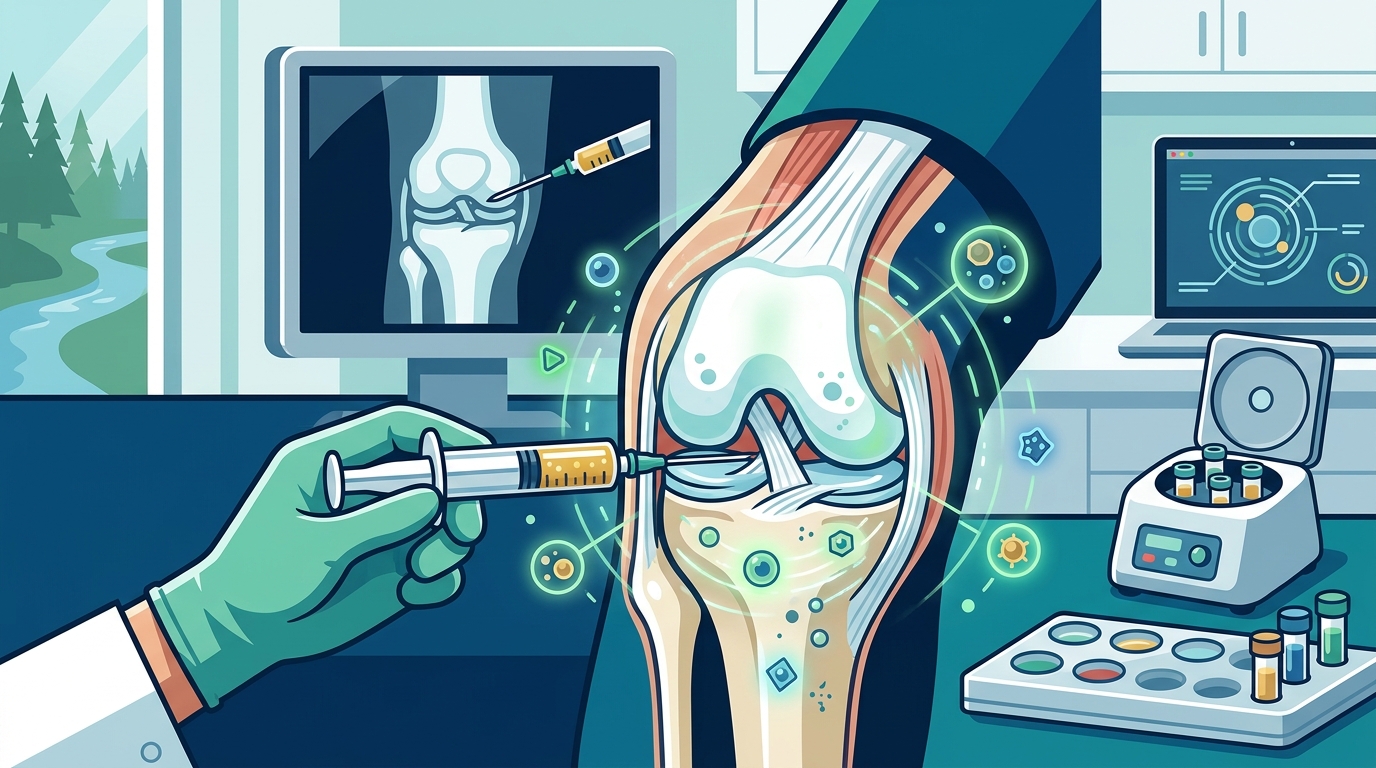
How Prolotherapy Works
The dextrose solution creates a controlled inflammatory response at the injection site. This mild irritation activates the body's wound repair cascade, recruiting growth factors and repair cells. Studies show that elevated dextrose concentrations enhance cellular proliferation and upregulate type 1 and type 3 collagen expression in tenocytes, supporting tendon and ligament repair.
Conditions Treated
Prolotherapy is effective for mild-to-moderate osteoarthritis, chronic sprains, sacroiliac pain, TMJ dysfunction, and joint instability conditions such as Ehlers-Danlos syndrome. It is a cost-effective starting point for many patients.
PRP Therapy: Concentrated Growth Factors for Tissue Repair
Platelet-rich plasma (PRP) is a regenerative injection therapy that concentrates platelets from a patient's own blood to deliver potent growth factors directly to an injury site. PRP is defined as one million or more platelets per microliter in a small volume of plasma with a full complement of growth and repair factors.
The Science Behind PRP
Platelets contain tiny alpha granules that release over 100 cell-signaling molecules, including PDGF, TGF-beta, VEGF, and EGF. When concentrated and injected, PRP induces new collagen production by fibroblasts, bone cells, and cartilage cells. This new collagen is incorporated into existing tissue, making ligaments and tendons thicker and stronger. According to Mass General Brigham, platelets contain hundreds of proteins called growth factors that play a role in healing injuries.
Why PRP Quality Matters
Not all PRP preparations are equal. Most positive outcome studies support a platelet concentration of 4x to 6x the patient's normal level. Oregon Regenerative Medicine is one of the few clinics in the Pacific Northwest that analyzes every PRP sample in-house before injection, confirming 1 to 2 billion platelets per milliliter to ensure biologic potency.
Adipose Stem Cell Therapy: Advanced Biocellular Regeneration
Adipose tissue stem cell therapy is a form of biocellular regenerative injection that uses mesenchymal stem cells (MSCs) harvested from a patient's own fat tissue. Adipose tissue is the most abundant source of reparative cells in the human body, containing at least 1,000 times more pluripotent cells than bone marrow aspirate.
Mechanism of Action
When injected into a diseased joint, adipose-derived stem cells neutralize the chronic inflammatory environment through cytokine recruitment, function as immunomodulators to clear damaged tissue, and then proliferate cell lines that produce bone and cartilage. Combined with PRP, these tissue products provide the cytokines, cell signaling, and scaffolding necessary for MSCs to differentiate and repair target injuries.
FDA Compliance
At Oregon Regenerative Medicine, adipose stem cell protocols are autologous (derived from the patient), minimally manipulated, and intended for homologous use, maintaining FDA compliance. Over 12,000 published studies have reported on stem cell characteristics in adipose tissue grafts.
Comparing Regenerative Injection Therapies
| Feature | Prolotherapy | PRP | Adipose Stem Cell Graft |
|---|---|---|---|
| Active Agent | Dextrose solution | Concentrated platelets & growth factors | Mesenchymal stem cells + tissue matrix |
| Source | Pharmaceutical grade dextrose | Patient's own blood | Patient's own adipose tissue |
| Primary Mechanism | Controlled inflammatory response | Growth factor delivery & collagen production | Immunomodulation, cytokine signaling, tissue differentiation |
| Best For | Mild-to-moderate joint instability, chronic sprains | Tendon injuries, moderate osteoarthritis, sports injuries | Advanced osteoarthritis, cartilage loss, surgery alternatives |
| Typical Sessions | 4-6 treatments | 2-3 treatments | 1-2 treatments |
| Relative Cost | Lowest | Moderate | Highest |
Why Precision Guidance Matters
The success of any regenerative injection depends on accurate placement. Ultrasound-guided and fluoroscopy-guided injections ensure the biologic agent reaches the exact site of tissue damage. Oregon Regenerative Medicine uses four Sonosite ultrasound systems and a GE OEC One Flat Panel C-Arm for fluoroscopic guidance during spinal procedures.
As Dr. Kristian Flores has noted, positive results ultimately come down to three essential skills: accurate diagnosis, accuracy of injections, and the purity and potency of the biologic product injected. Image guidance removes guesswork and increases treatment precision significantly.
Key Takeaways
- Regenerative medicine injections promote healing by reactivating the body's stalled repair cascade rather than masking pain.
- Prolotherapy uses dextrose to trigger a controlled inflammatory response that recruits repair cells and stimulates collagen production.
- PRP concentrates your own platelets to deliver over 100 growth factors directly to injured tissue, promoting new collagen and cartilage formation.
- Adipose stem cell therapy provides the highest regenerative potency, with MSC concentrations 1,000 times greater than bone marrow.
- PRP quality varies dramatically between clinics; lab-verified platelet concentrations of 4x-6x baseline are essential for clinical effectiveness.
- Ultrasound and fluoroscopic guidance improve injection accuracy, directly impacting treatment outcomes.
- Most patients can remain active during treatment, with recovery time that is swift compared to surgical alternatives.
Frequently Asked Questions
What is regenerative injection therapy?
Regenerative injection therapy is a category of non-surgical procedures that use biological agents such as dextrose, platelet-rich plasma, or stem cells to stimulate your body's natural healing mechanisms and repair damaged tendons, ligaments, and joints.
How does PRP promote joint healing?
PRP works by concentrating platelets from your own blood and injecting them into the injury site. These platelets release growth factors that stimulate new collagen production, recruit repair cells, and reduce inflammation, restarting the body's natural healing cascade.
Is prolotherapy the same as PRP?
No. Prolotherapy uses a dextrose solution to trigger an inflammatory healing response, while PRP uses concentrated platelets with biologically active growth factors. PRP is generally more potent and may require fewer treatment sessions, though both therapies can be effective depending on injury severity.
What conditions can regenerative injections treat?
Regenerative injections are used for osteoarthritis of the knee, hip, shoulder, and spine; tendon injuries such as rotator cuff tears and tennis elbow; chronic ligament sprains; sacroiliac pain; meniscus tears; and plantar fasciitis, among other musculoskeletal conditions.
Are regenerative injections safe?
Yes. PRP and prolotherapy use your own blood or biocompatible solutions, making the risk of allergic reaction or rejection extremely low. The platelet-rich substances used are actively anti-microbial, further reducing infection risk. Side effects are typically limited to temporary soreness at the injection site.
How many treatments will I need?
Treatment frequency depends on the therapy and condition. Prolotherapy typically requires 4 to 6 sessions, PRP generally requires 2 to 3, and adipose stem cell therapy often requires only 1 to 2 treatments. Your physician will create a personalized plan based on your diagnosis.
Should I avoid NSAIDs before PRP treatment?
Yes. Research published in the Orthopaedic Journal of Sports Medicine (2015) showed that NSAIDs significantly inhibit platelet function. Patients should avoid NSAID use for at least five days before PRP treatment to ensure optimal healing response.
What makes Oregon Regenerative Medicine different?
Oregon Regenerative Medicine has been practicing regenerative orthopedic medicine in Lake Oswego, Oregon, since 1978. The practice has performed over 40,000 regenerative injections, analyzes every PRP sample in its own laboratory, and uses advanced ultrasound and fluoroscopic C-Arm guidance for precision treatment.
Ready to Explore Regenerative Joint Healing?
If you are living with chronic joint pain, osteoarthritis, or a sports injury and want to explore non-surgical treatment options, contact Oregon Regenerative Medicine in Lake Oswego to schedule a consultation. Their team will perform a thorough evaluation, including diagnostic ultrasound imaging, to determine whether prolotherapy, PRP, or adipose stem cell therapy is right for your condition.