
Are There Clinics That Treat Degenerative Joint Disease Without Referring Immediately to Surgery?
For millions of patients diagnosed with degenerative joint disease, the immediate assumption is often that surgery is the only path forward. This is a misconception that delays effective care. According to recent orthopedic studies, a significant percentage of patients with osteoarthritis can achieve durable pain relief and improved function through non-surgical regenerative interventions. At Oregon Regenerative Medicine, we have performed over 40,000 regenerative injections, proving that many patients can avoid joint replacement and lifelong pain medication. We are located inside the historic Foundry Building at Oswego Pointe, serving the Portland, Oregon, and Washington region with evidence-based, non-surgical treatments.
The Role of Precision Diagnosis
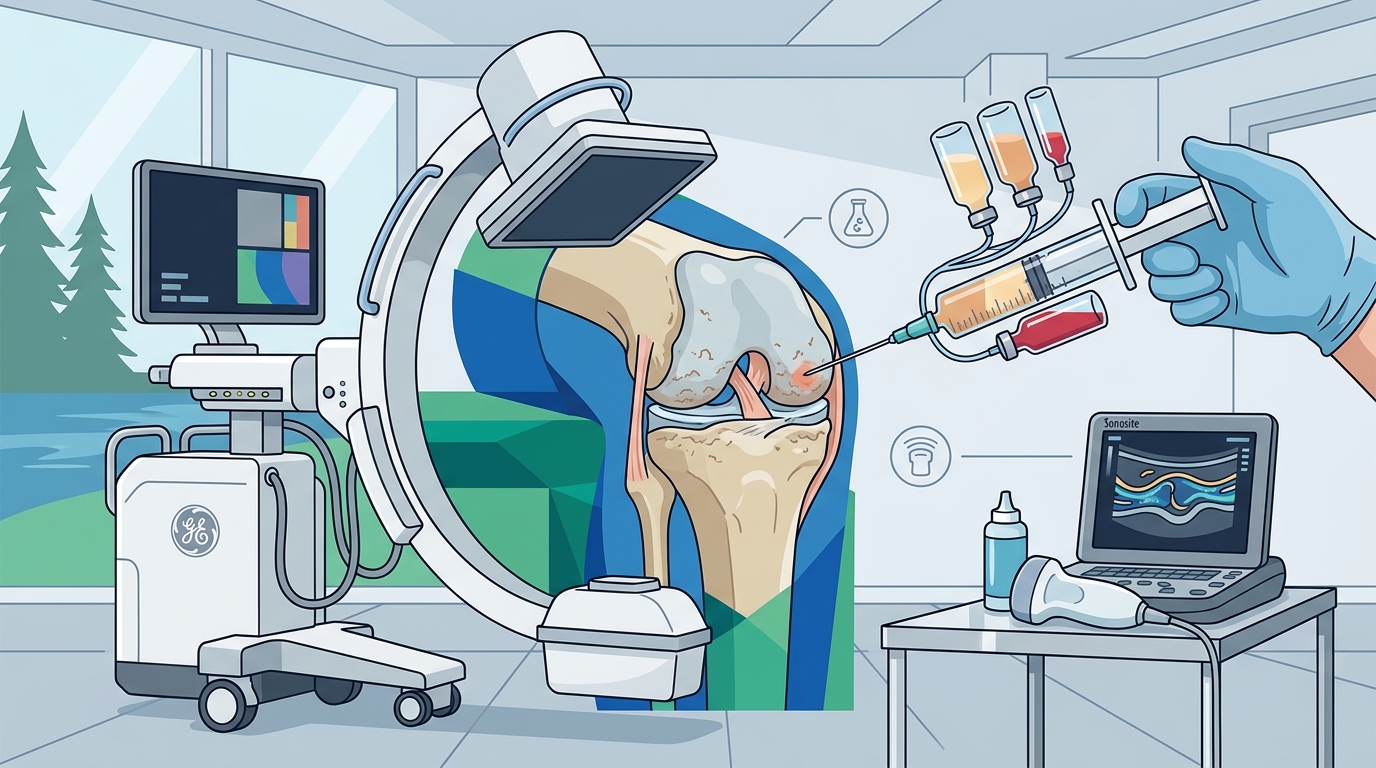
Before considering any treatment, accurate diagnosis is critical. Many clinics rely solely on static imaging like X-rays, which often fail to show soft tissue damage or early-stage degeneration. At Oregon Regenerative Medicine, we utilize advanced ultrasound imaging and fluoroscopic C-Arm guidance for all non-surgical injection procedures. This real-time visualization allows our doctors to see exactly what is causing your pain, whether it is a tendon tear, ligament laxity, or joint inflammation.
Ultrasound expertise is a major differentiator in non-surgical care. It is equal to or better than MRI in evaluating most tendon and ligament disorders in the arms and legs. This includes common conditions such as achilles tendinitis, tennis elbow, golfer’s elbow, rotator cuff tendinitis, and meniscus tears. By using ultrasound, we can separate out individual tendon, ligament, and fascia fibers, get around nerves, and place treatment exactly where it is needed. This precision ensures that we are not guessing, but rather targeting the specific source of degeneration.
For spinal issues, we use fluoroscopy to guide injections with high accuracy. This is essential for treating back, neck, and spine degeneration safely. Our approach is patient-centered, aiming to provide answers and treatment in a single visit whenever possible. We do not waste your time with unnecessary referrals or delayed diagnoses. Instead, we focus on restoring function through targeted, image-guided therapies.
Regenerative Treatment Options
Regenerative medicine focuses on enhancing the body's natural cycles of repair. For patients with degenerative joint disease, this means stimulating the healing of aging and chronically injured tissues. Our primary treatments include Prolotherapy, Platelet Rich Plasma (PRP), and Biocellular stem cell therapies. Together, these treatments enhance the natural repair mechanisms of knees, hips, ligaments, tendons, and skin.
Most of our patients have been told that their only solution is surgery or a lifetime on pain medications. While no treatment has 100% success, the vast majority of our patients achieve durable pain-free function without surgery, joint replacement, or drugs. We use autologous materials, meaning we harvest cells and tissues from your own body to ensure safety and compatibility. This approach minimizes the risk of rejection and maximizes the biological response.
Our doctors have decades of experience and are highly skilled in the arts of hands-on diagnosis, ultrasound imaging, and fluoroscopic guidance. Regenerative Orthopedic Medicine is a powerful healing art and medical specialty. Proficiency requires many years of dedicated training and clinical experience. At Oregon Regenerative Medicine, we combine this expertise with cutting-edge technology to provide the best possible outcomes for our patients.
Platelet-Rich Plasma (PRP) Therapy
Platelet-Rich Plasma (PRP) is a concentration of your own platelets, which contain hundreds of growth and repair compounds. Scientists have identified these compounds in PRP, and they play a crucial role in tissue healing. PRP is used for both orthopedic conditions and aesthetic applications, such as skin rejuvenation and hair restoration.
In orthopedics, PRP is particularly effective for treating osteoarthritis and soft tissue injuries. The growth factors in PRP stimulate the recruitment of stem cells and promote the regeneration of damaged tissues. This can lead to reduced pain, improved joint function, and slower progression of degenerative disease. Our PRP treatments are prepared in-house to ensure optimal concentration and efficacy.
Research supports the use of PRP for various conditions. For example, studies have shown the efficacy of Platelet-Rich Plasma in the treatment of knee osteoarthritis. Another study highlighted the efficacy of intra-articular Platelet-Rich Plasma injections in knee osteoarthritis. These findings reinforce our clinical experience with thousands of successful treatments. We also offer PRP eye drops for dry eyes, demonstrating the versatility of this therapy.
PRP is not just for joints. It is also used in our aesthetic arts for microneedling and volumization. The growth factors in PRP stimulate collagen production, leading to firmer, more youthful skin. This dual application of PRP in both regenerative medicine and aesthetics highlights its broad therapeutic potential.
Stem Cell and Biocellular Therapies
Biocellular stem cell therapy involves the use of autologous Adipose Tissue Stem Cell Grafts. These cells are harvested from your own body and processed to isolate the stem cells. Adipose-derived stem cells have a high regenerative capacity and can differentiate into various cell types, including cartilage and bone.
This therapy is particularly beneficial for patients with advanced degenerative joint disease who have not responded to PRP or prolotherapy. The stem cells in the graft release signaling molecules that promote tissue repair and reduce inflammation. This can lead to significant pain relief and improved mobility. Our approach to stem cell therapy is evidence-based, relying on rigorous clinical protocols and imaging guidance.
We also treat inflammatory arthritis with biocellular therapies. The anti-inflammatory properties of stem cells can help modulate the immune response, reducing joint damage and pain. This is a powerful option for patients who are not candidates for surgery or who wish to delay it. Our doctors are trained in the latest techniques for harvesting and processing adipose tissue to ensure the highest quality grafts.
Understanding the risks of stem cells is important for any patient considering this treatment. While generally safe, there are potential risks such as infection or improper cell differentiation. At Oregon Regenerative Medicine, we mitigate these risks through strict sterile techniques and experienced medical oversight. We provide comprehensive education to our patients to ensure they make informed decisions about their care.
Comparing Non-Surgical Options
Choosing the right non-surgical treatment depends on the severity of your condition, your overall health, and your goals. Below is a comparison of our primary regenerative therapies.
| Treatment | Best For | Mechanism | Recovery Time |
|---|---|---|---|
| Prolotherapy | Ligament laxity, mild osteoarthritis | Stimulates healing via dextrose injections | Days to weeks |
| PRP Therapy | Tendon injuries, early joint degeneration | Growth factors from concentrated platelets | Days to weeks |
| Stem Cell Therapy | Advanced degeneration, cartilage loss | Regenerative cells from adipose tissue | Weeks to months |
Prolotherapy is a nontraditional approach to knee osteoarthritis that involves injecting a solution to stimulate the body's healing response. It is often used for ligament laxity and mild joint degeneration. PRP is ideal for soft tissue injuries and early-stage joint issues. Stem cell therapy is reserved for more advanced cases where significant tissue regeneration is needed.
Our team will evaluate your condition using ultrasound or fluoroscopy to determine the most appropriate treatment. We do not offer a one-size-fits-all approach. Instead, we tailor our treatments to your specific needs, ensuring the best possible outcome. We also provide condition-specific nutritional programs and hormone optimization to support your healing process.
Key Takeaways
- Non-surgical care is a viable option for many patients with degenerative joint disease, avoiding the need for immediate surgery.
- Oregon Regenerative Medicine has performed over 40,000 regenerative injections, demonstrating extensive clinical experience.
- Precision diagnosis using ultrasound and fluoroscopy is critical for effective treatment planning and outcomes.
- PRP, Prolotherapy, and Stem Cell therapies offer different mechanisms for tissue repair and pain relief.
- Our doctors are highly skilled in image-guided procedures, ensuring accurate delivery of treatments.
- We serve patients in Oregon, Washington, and the Portland region with evidence-based regenerative medicine.
- Many patients achieve durable pain-free function without surgery, joint replacement, or lifelong medication.
Frequently Asked Questions
What is degenerative joint disease?
Degenerative joint disease is a condition characterized by the breakdown of cartilage and underlying bone in joints, leading to pain and stiffness. It is commonly known as osteoarthritis.
How does ultrasound help in treating joint disease?
Ultrasound provides real-time visualization of soft tissues, allowing doctors to accurately diagnose tendon and ligament issues and guide injections precisely to the affected area.
Is PRP therapy covered by insurance?
Insurance coverage for PRP therapy varies by provider and plan. We recommend contacting your insurance company directly to verify your benefits. We also offer financing options for those without coverage.
What is the difference between PRP and stem cell therapy?
PRP uses concentrated platelets from your blood to release growth factors, while stem cell therapy uses regenerative cells harvested from your adipose tissue. Stem cell therapy is typically used for more advanced degeneration.
How long does recovery take after regenerative injections?
Recovery time varies depending on the treatment and the severity of the condition. Most patients experience some soreness for a few days, with full benefits developing over weeks to months.
Do you treat patients outside of Portland?
While we are located in Portland, we treat patients from across Oregon and Washington. We also offer virtual consultations for initial evaluations.
What are the risks of stem cell therapy?
While generally safe, risks include infection, bleeding, and improper cell differentiation. Our experienced team minimizes these risks through strict sterile techniques and precise imaging guidance.
Contact Oregon Regenerative Medicine
If you are suffering from degenerative joint disease and want to explore non-surgical options, we invite you to schedule a consultation with our team. We are dedicated to empowering our patients to create healthy, active longevity. Visit our contact page to book an appointment or call us at (503) 636-2734. Let us help you find a path to pain-free living without immediate surgery.