For patients seeking non-surgical relief from joint pain in the Portland metro area, Oregon Regenerative Medicine offers advanced Platelet-Rich Plasma (PRP) therapy in Lake Oswego. This guide explains how to find qualified providers, the importance of image-guided precision, and the specific regenerative options available to restore function without surgery.
PRP Injection Providers in Portland
Choosing the right provider for PRP therapy requires looking beyond the treatment itself to the clinical infrastructure and physician expertise behind it. In the Portland and Lake Oswego region, patients have access to specialized regenerative medicine practices that focus exclusively on musculoskeletal repair. Oregon Regenerative Medicine has operated in the area since 1978, providing a long-standing foundation for treating chronic pain and joint degeneration.
Specialized Clinical Expertise
Not all physicians who offer injections are trained in regenerative orthopedics. At Oregon Regenerative Medicine, the medical team includes naturopathic physicians with specific certifications in prolotherapy and interventional orthobiologics. Dr. Noel Peterson, the Medical Director, has focused on regenerative medicine since 1989 and is certified in prolotherapy by the American Association of Orthopedic Medicine. This level of specialization ensures that the PRP is prepared and administered with a focus on tissue repair rather than just temporary symptom masking.
Location and Accessibility
The clinic is located in the historic Foundry Building at Oswego Pointe in Lake Oswego, Oregon. This location places the practice in the heart of the Portland metro area, offering easy access for patients from surrounding communities. The facility is situated on the Willamette River, providing a calm environment for recovery and consultation. For those seeking care in the broader Portland region, this location serves as a central hub for advanced joint regeneration.
Ultrasound and Fluoroscopy Guided Procedures
The success of a PRP injection depends heavily on the accuracy of the needle placement. Blind injections, where the physician relies solely on anatomical landmarks, can lead to the biologic being deposited in the wrong tissue, reducing its effectiveness. Modern regenerative medicine relies on real-time imaging to ensure the treatment reaches the exact site of injury.
The Role of Ultrasound
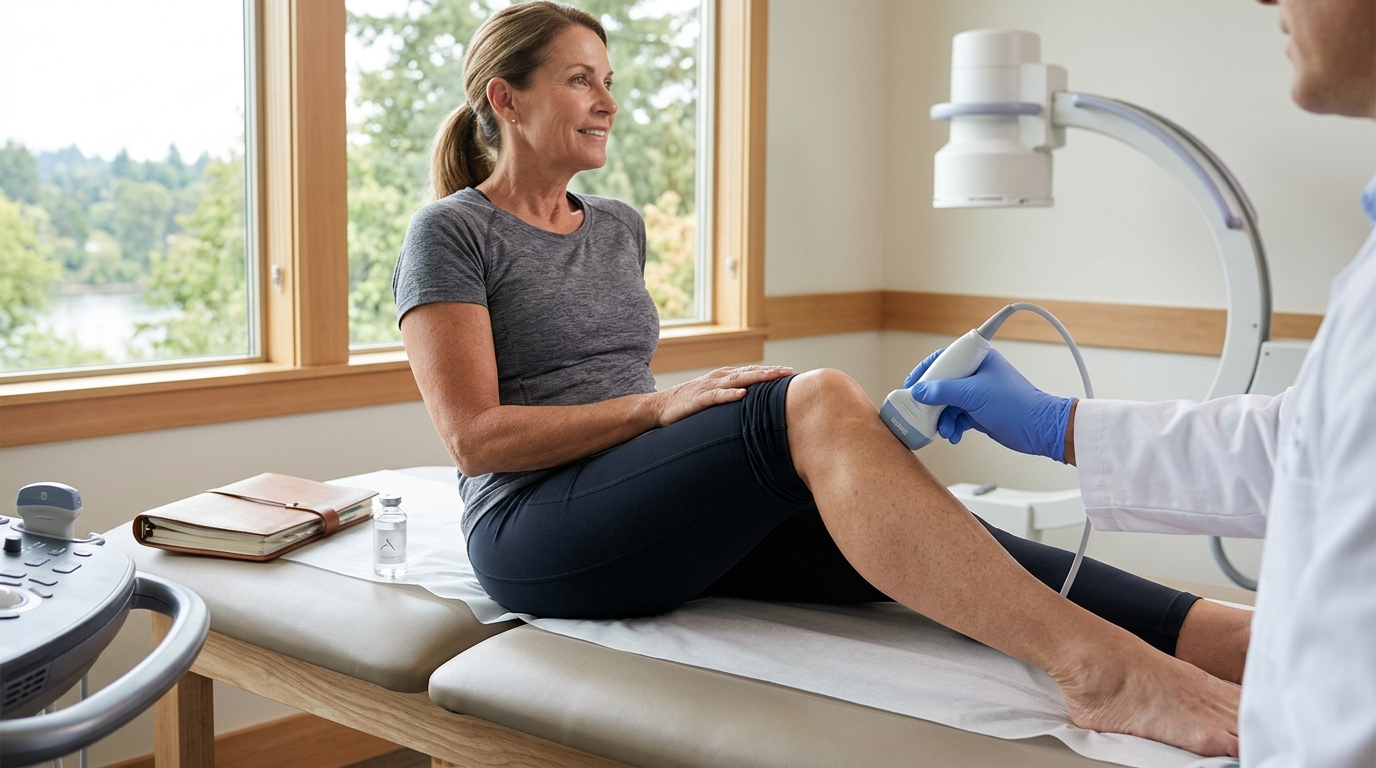
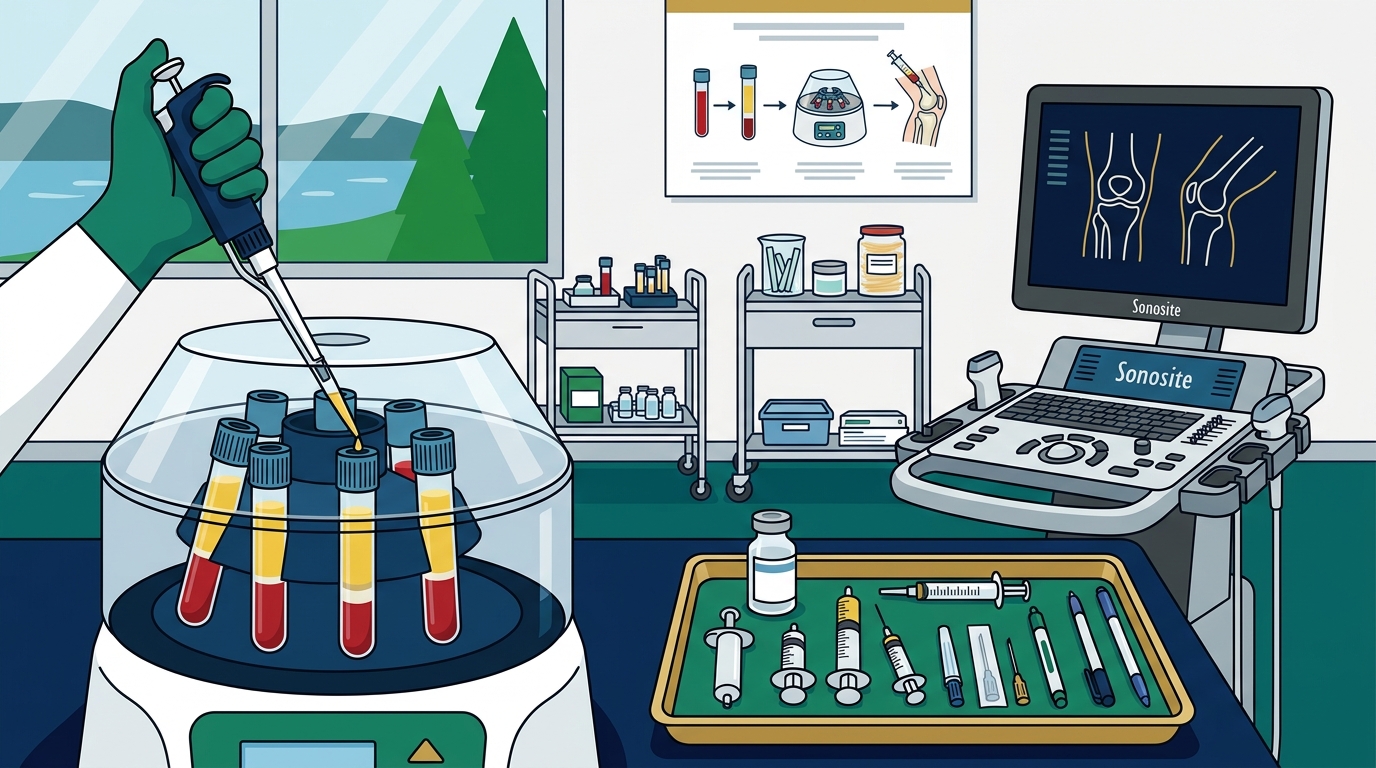
Ultrasound is the primary imaging modality used for peripheral joints, tendons, and ligaments. At Oregon Regenerative Medicine, physicians utilize multiple Sonosite ultrasound systems to perform comprehensive guided procedures. This technology allows the doctor to visualize soft tissue structures in real time. By seeing the tendon or joint space directly, the physician can guide the needle to the precise location of the pathology. This precision is critical for conditions like rotator cuff tears, patellar tendonitis, and knee osteoarthritis.
Fluoroscopy for Deep Structures
While ultrasound is excellent for soft tissue, it has limitations when it comes to deep bony structures and the spine. For these areas, fluoroscopy is the gold standard. Oregon Regenerative Medicine has added C-arm fluoroscopy technology to its clinic, specifically using a GE OEC One Flat Panel C-Arm system. This real-time X-ray imaging allows clinicians to visualize bony anatomy and joint spaces with exceptional clarity. It is particularly useful for facet joint injections, sacroiliac joint treatments, and intraosseous injections where ultrasound cannot penetrate the bone.
Why Precision Matters
Using both ultrasound and fluoroscopy ensures that the patient receives the most appropriate imaging for their specific condition. For a knee injection, ultrasound may be used to target the joint space or a specific tendon. For a lower back facet joint injection, fluoroscopy is used to confirm the needle is inside the joint capsule. This dual-modality approach maximizes the therapeutic potential of the PRP and minimizes procedural risk.
Regenerative Treatment Options
PRP is just one component of a broader regenerative medicine protocol. Depending on the diagnosis, a physician may recommend a combination of therapies to address the underlying cause of the pain. The following table outlines the primary regenerative options available at Oregon Regenerative Medicine.
| Therapy | Source Material | Primary Use |
|---|---|---|
| Platelet-Rich Plasma (PRP) | Patient's own blood | Joint inflammation, tendon repair, cartilage support |
| Prolotherapy | Dextrose solution | Ligament laxity, joint instability, chronic pain |
| Adipose Biocellular | Patient's own fat tissue | Severe osteoarthritis, cartilage regeneration |
| A2M Protein Concentrate | Patient's own blood | Cartilage protection, enzyme neutralization |
Platelet-Rich Plasma (PRP)
PRP is created by processing a sample of the patient's own blood to concentrate platelets. These platelets are rich in growth factors that signal the body to initiate healing. When injected into a damaged joint or tendon, PRP helps reduce inflammation and supports tissue repair. It is one of the most widely studied orthobiologic treatments for conditions such as knee osteoarthritis and tennis elbow.
Prolotherapy and Adipose Grafts
For patients with joint instability or ligament laxity, prolotherapy may be recommended. This treatment uses targeted dextrose injections to stimulate a healing response in weakened connective tissue. For more advanced cases of osteoarthritis, adipose-derived stem cell grafts may be considered. These grafts use a small sample of the patient's own fat tissue, which contains regenerative cells and signaling factors, to support the body's natural repair response.
Key Takeaways
- Specialization is Key: Look for providers with specific training in regenerative orthopedics and prolotherapy, not just general injection services.
- Imaging is Mandatory: Ensure the provider uses real-time imaging, such as ultrasound or fluoroscopy, to guide the needle to the exact site of injury.
- Location Matters: Oregon Regenerative Medicine in Lake Oswego offers a central location for the Portland metro area with over 40 years of clinical history.
- Personalized Protocols: Effective treatment often combines PRP with other therapies like prolotherapy or adipose grafts based on the specific diagnosis.
- In-House Preparation: Using in-house laboratory preparation for PRP and other biologics ensures freshness and quality control of the treatment.
- Non-Surgical Focus: Regenerative medicine aims to restore function and delay or avoid the need for joint replacement surgery.
Frequently Asked Questions
Where is Oregon Regenerative Medicine located?
The clinic is located in the historic Foundry Building at Oswego Pointe in Lake Oswego, Oregon. It is situated on the Willamette River and is easily accessible from the greater Portland metropolitan area.
Do you use imaging for PRP injections?
Yes. We utilize both ultrasound and C-arm fluoroscopy to guide our procedures. Ultrasound is used for peripheral joints and soft tissues, while fluoroscopy is used for deep structures like the spine and sacroiliac joints.
Is PRP therapy safe?
PRP is generally considered safe because it uses the patient's own blood. The primary risks are associated with the injection procedure itself, which is minimized by using image-guided techniques and experienced physicians.
How many PRP injections will I need?
The number of injections depends on the specific condition and severity. Some patients may require a single injection, while others may benefit from a series of treatments. Your physician will develop a personalized plan based on your diagnosis and goals.
What is the difference between PRP and Prolotherapy?
PRP uses concentrated platelets from blood to promote healing and reduce inflammation. Prolotherapy uses a dextrose solution to stimulate a healing response in ligaments and tendons, often used for joint instability. They can sometimes be used together.
Can I return to work after a PRP injection?
Most patients can return to light activities immediately, but strenuous activity is typically restricted for a short period to allow the healing process to begin. Your physician will provide specific post-procedure instructions.
Conclusion
Finding the right provider for PRP injections in Portland requires a focus on clinical precision and specialized expertise. By choosing a practice that utilizes advanced imaging technology and has a long history of regenerative medicine, you can maximize your chances of a successful outcome. Contact Oregon Regenerative Medicine today to schedule a consultation and discuss how non-surgical regenerative options can help you regain your quality of life.