

Yes. Some clinics evaluate degenerative joint disease with the goal of preserving the natural joint and improving function before recommending surgery. These practices may offer a coordinated plan that includes activity modification, rehabilitation, image-guided injections, platelet-rich plasma (PRP), prolotherapy, and autologous adipose tissue graft therapies when appropriate.
That does not mean surgery is never necessary. Advanced bone-on-bone arthritis, major deformity, fracture, infection, rapidly worsening neurological symptoms, or severe loss of function may require an orthopedic surgical opinion. However, a surgical referral does not always need to be the first or only step. A thorough non-surgical evaluation can help clarify the source of pain, identify treatable supporting-tissue problems, and determine whether preserving the joint is a reasonable goal.
In the Portland metropolitan area, Oregon Regenerative Medicine in Lake Oswego provides non-surgical regenerative and integrative medicine for osteoarthritis, joint injuries, tendon and ligament problems, and acute or chronic pain. The practice describes its approach as personalized, using medical history, physical examination, X-rays, MRI review, diagnostic ultrasound, and image-guided procedures to determine which treatments may fit a patient’s condition.
The short answer: some clinics do offer a surgery-sparing evaluation
Degenerative joint disease, commonly called osteoarthritis, can involve more than worn cartilage. Pain may also be influenced by ligament laxity, tendon injury, altered joint mechanics, inflammation, muscle weakness, nerve irritation, or problems in nearby joints and the spine. A clinic that focuses only on an X-ray description may miss contributors that can be addressed without an operation.
A non-surgical regenerative medicine evaluation generally asks several practical questions:
- Where is the patient’s pain actually coming from?
- Is the joint stable, or are weakened ligaments contributing to abnormal motion?
- Are tendons, bursae, nerves, or adjacent joints involved?
- How much structural degeneration is present?
- What are the patient’s goals for walking, exercise, work, sleep, or sport?
- Would rehabilitation, injection therapy, lifestyle support, or a combination be reasonable?
- Are there warning signs that make surgical, neurological, or emergency evaluation more appropriate?
The best clinics do not promise that every patient can avoid joint replacement. Instead, they explain the likely benefits, limitations, risks, costs, recovery expectations, and alternatives before treatment begins.
What a non-surgical clinic should evaluate before recommending treatment
1. Symptoms and functional limitations
A useful consultation goes beyond asking whether a joint hurts. The clinician should understand when symptoms began, whether pain occurs at rest or with movement, how far the patient can walk, whether the joint gives way, and which activities have become difficult. Sleep disruption, work limitations, swelling, stiffness, and previous injuries may influence the treatment plan.
2. Physical examination and joint mechanics
The examination may assess range of motion, strength, ligament stability, alignment, gait, tenderness, muscle activation, and referred pain. For example, knee pain may be affected by hip weakness, foot mechanics, meniscal injury, ligament laxity, or lumbar spine problems. Treating the wrong structure can lead to disappointing results regardless of the injection used.
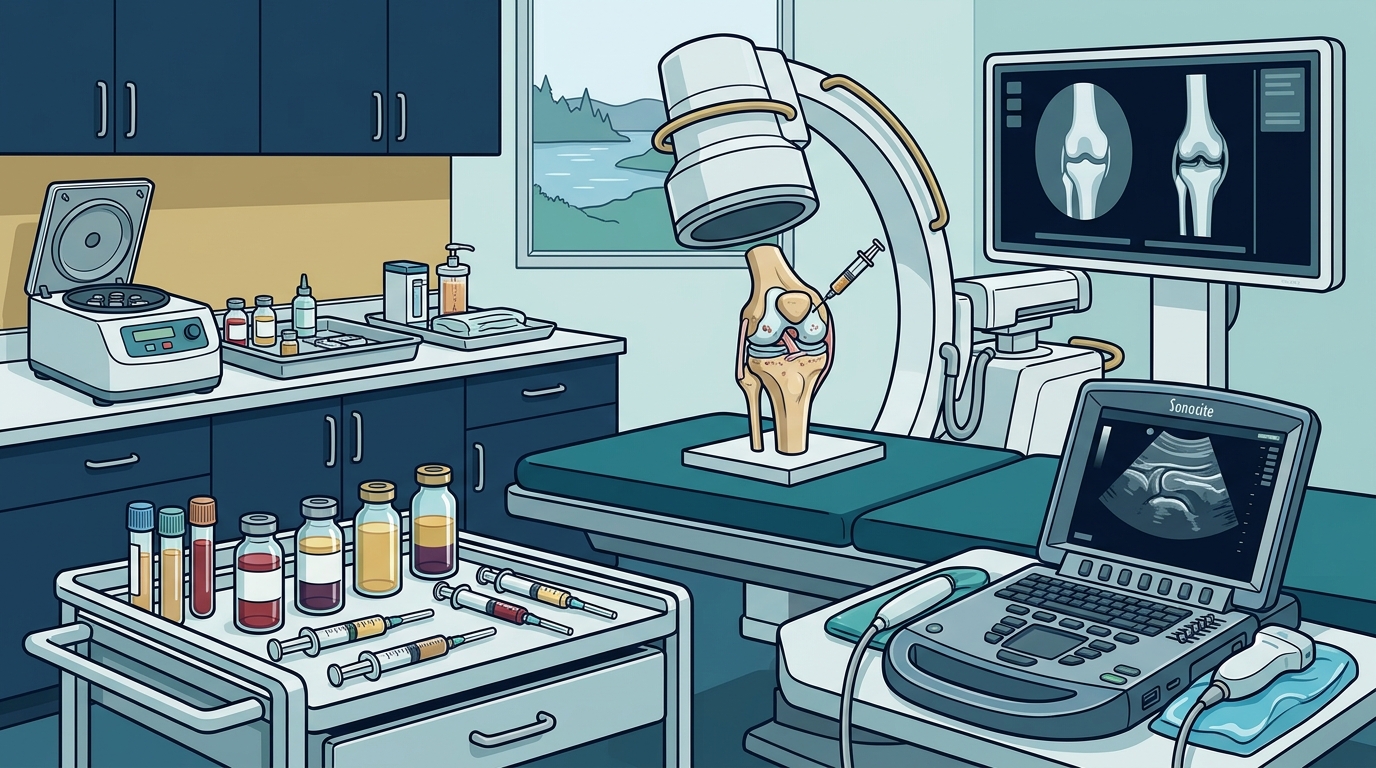
3. Existing imaging and, when useful, dynamic ultrasound
X-rays can show joint-space narrowing, bone spurs, alignment, and other signs of osteoarthritis. MRI may help evaluate cartilage, menisci, tendons, ligaments, discs, and other soft tissues. Musculoskeletal ultrasound can provide a real-time view of tendons, ligaments, fluid collections, and moving structures while also helping guide an injection.
Oregon Regenerative Medicine states that it reviews X-rays and MRIs and performs diagnostic ultrasound before deciding whether a patient is a suitable candidate. Its practice information also describes ultrasound as a way to correlate hands-on examination with real-time tissue imaging.
4. Medical history and treatment risks
Blood-thinning medication, immune-system conditions, active infection, uncontrolled diabetes, bleeding disorders, recent surgery, cancer history, pregnancy, and other health factors may affect whether an injection is appropriate. A qualified provider should review medications and health history rather than treating an imaging report in isolation.
Non-surgical treatment options used by regenerative medicine clinics
There is no single injection that works for every joint or every stage of osteoarthritis. Regenerative medicine clinics may combine procedures with rehabilitation, nutritional support, strength training, ergonomic changes, weight-management strategies, and treatment of related pain generators.
Platelet-rich plasma therapy
PRP is prepared from a patient’s own blood. A sample is processed to concentrate platelets and plasma, which contain signaling proteins involved in the body’s repair response. The resulting preparation is injected into a selected joint, tendon, ligament, or other target area.
PRP preparations vary considerably. Differences may include platelet concentration, red and white blood cell content, activation method, volume, processing system, and injection technique. This variability is one reason research findings are not always consistent. The American Academy of Orthopaedic Surgeons states that PRP may reduce pain and improve function for some patients with symptomatic knee osteoarthritis, while also noting that more research is needed regarding treatment protocols. The American College of Rheumatology and Arthritis Foundation guideline has been more cautious because of the heterogeneity and lack of standardization in available PRP preparations.
Patients considering PRP should ask how the clinic prepares the product, whether the preparation is analyzed, which anatomy will be treated, how many injections may be recommended, and how outcomes will be measured. Oregon Regenerative Medicine provides additional information about its approach on its Platelet Rich Plasma therapy page.
Prolotherapy
Prolotherapy, also called regenerative injection therapy, uses an injected solution to stimulate a localized healing response in selected ligaments, tendons, or other connective tissues. Dextrose-based solutions are commonly discussed in prolotherapy protocols. The intended goal is to address weakened or painful supporting tissues and improve joint stability or function.
Prolotherapy may be considered when examination suggests ligament laxity, tendon injury, or mechanical instability. It should not be presented as a guaranteed cartilage-restoration procedure, and patients should understand that evidence varies by condition and protocol. In its osteoarthritis guideline, the American College of Rheumatology conditionally recommends against prolotherapy for knee and hip osteoarthritis because available trials were limited and varied in injection sites, schedules, and comparisons. A careful clinic should discuss that uncertainty openly.
Learn more about the technique and how it may be used in a broader regenerative plan through Oregon Regenerative Medicine’s prolotherapy information.
Autologous adipose tissue graft therapy
Some regenerative medicine practices use tissue obtained from the patient’s own adipose tissue. Depending on the specific preparation and applicable regulations, the resulting autologous tissue graft may contain a mixture of cells, extracellular matrix, and signaling factors. These products are not identical to laboratory-expanded or embryonic stem cells, and terminology can vary between clinics.
Patients should ask exactly what product is being prepared, how it is processed, whether it is minimally manipulated, where it will be placed, what evidence supports its use for the specific joint, and what regulatory requirements apply. Autologous tissue procedures may involve additional cost, preparation, recovery, and risks compared with a standard injection.
Fluoroscopy-guided injections
Fluoroscopy uses real-time X-ray imaging to help a clinician place a needle accurately near deep spinal or joint structures. It can be particularly useful for selected spine, hip, and facet-related procedures where surface landmarks alone may not provide sufficient precision.
Oregon Regenerative Medicine describes fluoroscopy-guided procedures using a C-arm system for selected injections. Its information about fluoroscopy-guided spine injections in Portland explains why accurate delivery can be important when treating deeper anatomy.
Supportive and integrative care
Injection therapy is often only one part of a durable plan. Depending on the patient, supportive care may include progressive exercise, physical therapy, gait or movement retraining, nutrition counseling, sleep improvement, weight-management support, acupuncture, IV nutrient therapy, hormone evaluation, or management of chronic medical conditions. These services do not replace appropriate orthopedic or surgical care, but they may help address factors that influence pain, recovery, and activity tolerance.
Why precision imaging can change the treatment conversation
Image guidance is not simply a technological upgrade. It can help the clinician verify the intended target, account for individual anatomy, avoid sensitive structures, and document findings that may not be apparent during a static examination.
Ultrasound provides real-time visualization without ionizing radiation and can show certain structures during movement. It may be useful for evaluating superficial tendons, ligaments, muscles, bursae, and some joints. Fluoroscopy provides X-ray visualization and may be selected for deeper structures, including portions of the spine and hip.
Patients should ask whether a proposed injection is performed with ultrasound, fluoroscopy, or landmark guidance; why that method was selected; and whether the provider can explain the target anatomy. Imaging guidance improves procedural accuracy, but it does not guarantee symptom relief or eliminate all risks.
How common non-surgical options compare
| Option | Primary purpose | Often considered when | Important questions |
|---|---|---|---|
| PRP | Uses a patient-derived blood product containing concentrated platelets and plasma signaling factors. | There is symptomatic osteoarthritis or a tendon, ligament, or joint problem for which the provider believes biologic injection may be reasonable. | How is the PRP prepared and characterized? What evidence applies to this joint and protocol? |
| Prolotherapy | Uses an injected solution to stimulate a localized response in selected connective tissues. | Examination suggests ligament or tendon pain, laxity, or mechanical instability. | Which structure is being treated, and what are the expected benefits and limitations? |
| Autologous adipose tissue graft therapy | Uses a patient-derived adipose tissue preparation intended to provide tissue matrix and biological signaling. | The provider believes a more involved autologous tissue procedure may be appropriate after evaluation. | What exactly is being injected, how is it processed, and what evidence supports its use? |
| Fluoroscopy-guided injection | Uses real-time X-ray guidance to target selected deep structures. | The target is difficult to access accurately using surface landmarks alone. | Why is fluoroscopy preferred, and what are the radiation, medication, and procedural risks? |
Recovery varies by joint, diagnosis, injection type, activity level, and individual healing response. A clinic should provide written aftercare instructions and explain when gentle movement, work, driving, exercise, and higher-load activities may resume. Oregon Regenerative Medicine’s patient information notes that daily activities may resume within several days for many people, while more demanding activity is progressed more gradually.
Who may be a candidate for non-surgical joint care?
Potential candidates often include people with persistent joint pain who want to explore conservative options, patients with mild to moderate osteoarthritis, individuals with tendon or ligament injuries, and people who have been told surgery is an option but want a second opinion. Candidacy depends on the diagnosis, severity, anatomy, general health, medications, prior treatments, and personal goals.
People with advanced degeneration may still benefit from a comprehensive pain-management or function-focused plan, but regenerative injections may not restore a severely damaged joint. A responsible provider should say when expected benefits are limited and should recommend an orthopedic consultation when surgery may offer the most reliable outcome.
Seek urgent medical attention for a hot, red, acutely swollen joint with fever; a suspected fracture; sudden inability to bear weight after trauma; new bowel or bladder dysfunction; progressive weakness; saddle numbness; or other symptoms that may indicate infection, fracture, or neurological compromise.
Questions to ask before choosing a clinic
- How do you determine whether my pain is coming from the joint? Ask whether the evaluation includes a physical examination, imaging review, and assessment of nearby structures.
- Do you use ultrasound or fluoroscopy for injections? Find out whether guidance is routine or selected only for certain procedures.
- What treatment are you recommending and why? The explanation should connect the treatment to a specific diagnosis and goal.
- What evidence supports this approach for my joint? Ask about expected benefits, uncertainty, and reasonable alternatives.
- How is PRP or adipose tissue processed? Request plain-language information about preparation, testing, sterility, and the final product.
- How many visits or procedures might I need? Ask about the anticipated schedule, recovery periods, and follow-up measurements.
- What are the risks and contraindications? The provider should discuss infection, bleeding, post-injection flare, nerve or tissue injury, medication interactions, and procedure-specific risks.
- What happens if treatment does not help? A complete plan should include reassessment, rehabilitation, other conservative options, or referral when appropriate.
- What will insurance cover? Many regenerative procedures are self-pay or may have limited insurance coverage. Obtain a written estimate before treatment.
Key takeaways
- Yes, non-surgical clinics exist. Some practices evaluate degenerative joint disease with the aim of preserving natural anatomy and delaying or avoiding surgery when clinically reasonable.
- Avoiding immediate surgery is not the same as avoiding medical evaluation. A proper diagnosis is essential, especially when symptoms may originate outside the arthritic joint.
- PRP, prolotherapy, and autologous adipose tissue therapies are different procedures. They should not be treated as interchangeable, and evidence varies by condition, preparation, and technique.
- Research is still evolving. Major guidelines differ in their recommendations, particularly because PRP products and injection protocols are not standardized.
- Image guidance can improve targeting. Ultrasound and fluoroscopy may help providers visualize anatomy and place injections more precisely.
- Severe arthritis may still require surgery. A trustworthy clinic explains when regenerative care may have limited value and when an orthopedic referral is appropriate.
- Ask for a personalized plan. The best treatment decision considers diagnosis, imaging, health history, goals, recovery expectations, risks, and cost.
Frequently asked questions
Can degenerative joint disease be treated without surgery?
Often, symptoms and function can be managed without immediate surgery, particularly when the condition is mild to moderate or when pain is influenced by tendons, ligaments, muscles, movement patterns, or inflammation. Non-surgical care may include exercise, physical therapy, medication management, weight-management support, image-guided injections, PRP, prolotherapy, or other approaches. Severe structural damage may still make joint replacement or another operation the more appropriate option.
Does non-surgical treatment mean that the joint will be fully regenerated?
No. The term regenerative medicine refers to therapies intended to support repair, tissue healing, symptom improvement, or function. No injection can guarantee complete cartilage restoration or permanently reverse osteoarthritis. Patients should request realistic, condition-specific expectations.
Is PRP proven to work for osteoarthritis?
Evidence suggests that PRP may reduce pain and improve function for some people with symptomatic knee osteoarthritis, but results vary. Preparation methods and treatment protocols differ substantially. The American Academy of Orthopaedic Surgeons states that PRP may help some patients with knee osteoarthritis, while the American College of Rheumatology and Arthritis Foundation guideline has recommended against PRP for knee and hip osteoarthritis because of concerns about inconsistent preparations and limited standardization. Discuss the evidence for your specific joint and circumstances with a qualified clinician.
What is the difference between PRP and prolotherapy?
PRP is prepared from the patient’s blood and contains concentrated platelets and plasma components. Prolotherapy uses an injected solution intended to stimulate a localized response in selected connective tissues. The two therapies may be considered for different findings, and neither should be recommended without identifying the structures likely contributing to pain.
What is an autologous adipose tissue graft?
It is a patient-derived tissue preparation obtained from adipose tissue and used according to the clinic’s processing method and applicable regulations. It is not automatically equivalent to expanded stem-cell products or a guaranteed cartilage replacement. Ask exactly what is collected, processed, and injected, as well as what evidence and regulatory framework apply.
How long does it take to see results?
Timing varies. Some people notice changes within days or weeks, while others require several weeks or months as activity is gradually restored. Post-procedure soreness or a temporary flare can occur. The clinic should provide a recovery plan and define when progress will be reassessed.
Are regenerative injections covered by insurance?
Coverage varies by insurer, procedure, diagnosis, and plan. Many PRP, prolotherapy, and autologous tissue procedures are not fully covered and may be offered on a self-pay basis. Ask for an itemized estimate, payment policy, and information about financing before scheduling treatment.
When should I see an orthopedic surgeon instead of pursuing regenerative treatment?
An orthopedic consultation may be appropriate when imaging and examination show advanced joint destruction, major deformity, instability, fracture, or another condition for which surgery is likely to provide the most predictable benefit. An orthopedic opinion and a regenerative medicine consultation are not mutually exclusive; in some cases, patients use both to make an informed decision.
Explore your options with an Oregon regenerative medicine consultation
If you have been told that joint replacement or surgery is your only option, a second opinion may help you understand the full range of possibilities. Oregon Regenerative Medicine has served patients in Lake Oswego and the Portland region with regenerative and integrative care, including PRP, prolotherapy, autologous adipose tissue therapies, and image-guided injection procedures.
The practice is located at 320 Oswego Pointe Drive in Lake Oswego, Oregon. To discuss your symptoms, imaging, treatment history, and goals, visit the Oregon Regenerative Medicine contact page. A consultation cannot guarantee that surgery will be avoided, but it can help determine whether a personalized non-surgical plan is medically reasonable for you.
Medical disclaimer: This article is for educational purposes and is not a diagnosis or substitute for individualized medical advice. Regenerative procedures have potential risks, costs, and limitations. Treatment decisions should be made with a qualified healthcare professional who has reviewed your medical history and performed an appropriate evaluation.