

When shoulder, knee, or hip pain begins interfering with walking, sleeping, exercise, or work, many patients are quickly told that joint replacement is the next step. Surgery can be appropriate for advanced joint damage, but it is not always the only option—especially when pain is related to osteoarthritis that is not yet end-stage, tendon or ligament injury, joint instability, or inflammation around the joint.
The type of doctor to look for is a physician experienced in regenerative and interventional musculoskeletal medicine. This doctor evaluates the joint, identifies the structure causing pain, reviews imaging and medical history, and may use image-guided treatments such as platelet-rich plasma (PRP), prolotherapy, adipose tissue graft therapies, or other carefully selected injections. The goal is not to promise that every patient can avoid surgery. The goal is to determine whether a personalized non-surgical plan can reduce symptoms, improve function, and potentially postpone joint replacement.
At Oregon Regenerative Medicine, patients in Oregon and the greater Portland area can receive comprehensive evaluation and regenerative care for acute and chronic musculoskeletal pain, including shoulder, knee, and hip conditions.
What kind of doctor treats joint pain before replacement?
A doctor who helps patients explore alternatives to joint replacement is typically trained in physical medicine, sports medicine, naturopathic or integrative medicine, pain medicine, orthopedics, or another field with advanced expertise in musculoskeletal diagnosis and injection procedures. The important qualification is not a job title alone. It is experience accurately diagnosing the source of pain and matching treatment to the patient’s anatomy, goals, health history, and stage of joint degeneration.
A joint-preservation physician may treat more than the visible cartilage loss. Shoulder pain, for example, can originate from the rotator cuff, biceps tendon, labrum, joint capsule, or neck. Knee pain may involve cartilage, menisci, ligaments, tendons, alignment, or referred pain. Hip symptoms can arise from the hip joint, labrum, surrounding tendons, bursae, sacroiliac region, or lower back. Treating the wrong structure can lead to disappointing results, which is why diagnosis comes before injection selection.
At Oregon Regenerative Medicine, Dr. Kristian Flores and Dr. Noel Peterson provide regenerative and integrative medicine services. Dr. Noel Peterson has practiced naturopathic and regenerative medicine since 1978 and specializes in prolotherapy, PRP, and autologous adipose-tissue regenerative medicine in Portland and Lake Oswego. ([oregenmed.com](https://oregenmed.com/doctors/dr-noel-peterson/?utm_source=openai))
What should happen during a joint-preservation evaluation?
A responsible consultation should be more than a sales presentation for a procedure. It should establish whether the pain is coming from the joint itself, surrounding soft tissue, or another area. A comprehensive evaluation commonly includes:
- Medical history: The physician reviews when symptoms began, previous injuries, prior injections, medications, surgeries, activity limitations, and health conditions that may affect healing.
- Physical examination: Range of motion, strength, gait, stability, swelling, tenderness, and functional movements help identify the painful structure.
- Imaging review: X-rays may show joint-space narrowing, bone spurs, alignment changes, or other arthritis findings. MRI or ultrasound may help evaluate cartilage, tendons, menisci, labrum, bursae, and ligaments.
- Discussion of goals: A runner may want to return to training, while another patient may primarily want to sleep, walk stairs, or remain active with family.
- Risk-benefit counseling: The physician should explain expected benefits, limitations, alternatives, costs, recovery, and when surgical consultation is warranted.
Patients should be cautious of any clinic that guarantees cartilage regrowth, promises a permanent cure, or claims that a biologic procedure works for everyone. The U.S. Food and Drug Administration states that regenerative medicine therapies have not been approved for treating orthopedic conditions such as osteoarthritis, hip pain, knee pain, or shoulder pain, and warns about risks associated with illegally marketed products. ([fda.gov](https://www.fda.gov/vaccines-blood-biologics/consumers-biologics/important-patient-and-consumer-information-about-regenerative-medicine-therapies?utm_source=openai))
Non-surgical treatments a regenerative medicine doctor may consider
Treatment depends on the diagnosis. Some patients may benefit from one therapy, while others need a staged plan combining rehabilitation, activity modification, nutrition, strength training, and image-guided procedures.
Platelet-rich plasma therapy
PRP is prepared from a patient’s own blood. A small blood sample is processed to concentrate platelets and associated signaling proteins before the preparation is injected into a targeted joint, tendon, ligament, or other tissue. PRP is intended to support the body’s local healing response and may help reduce pain and improve function in selected patients.
Evidence is strongest and most developed for knee osteoarthritis, although study results vary according to patient selection, disease severity, PRP preparation, injection protocol, and comparison treatment. A 2023 systematic review and meta-analysis of 31 randomized clinical trials reported improvements in pain and function with PRP, while a 2025 placebo-controlled meta-analysis found benefits through approximately three to six months but described the overall efficacy as weak and clinically debatable. Patients should therefore view PRP as a possible treatment—not a guaranteed replacement for surgery or a proven method of rebuilding an entire joint. ([pubmed.ncbi.nlm.nih.gov](https://pubmed.ncbi.nlm.nih.gov/40653151/?utm_source=openai))
Learn more about preparation, possible uses, and treatment considerations in the PRP Therapy Guide.
Prolotherapy
Prolotherapy uses carefully administered injections intended to stimulate a localized healing response in selected ligaments, tendons, and joint-supporting tissues. It may be considered when ligament laxity, chronic sprain, or joint instability contributes to pain. Temporary soreness after treatment is possible, and the number of treatments depends on the condition and response.
Adipose tissue and cellular therapies
Some regenerative practices use a patient’s own adipose tissue as part of an autologous biologic treatment plan. Oregon Regenerative Medicine’s clinical capabilities include in-house preparation of biologic materials such as M-FAT, PRF, platelet lysates, and other preparations. The specific product, processing method, intended use, regulatory status, and supporting evidence should be explained clearly before treatment.
Patients should distinguish between an autologous tissue procedure and the broad claims often associated with “stem cell therapy.” The FDA warns that many unapproved stem-cell and exosome products are marketed for orthopedic conditions and may carry serious risks. A consultation should include a transparent explanation of what is actually being administered, how it is prepared, what evidence applies, and whether the treatment is part of an appropriately regulated clinical trial. ([fda.gov](https://www.fda.gov/vaccines-blood-biologics/consumers-biologics/important-patient-and-consumer-information-about-regenerative-medicine-therapies?utm_source=openai))
For background research, Oregon Regenerative Medicine provides additional information about mesenchymal stem cells and regenerative medicine research.
A2M injections
A2M injections are designed around alpha-2-macroglobulin, a naturally occurring protein that can bind and inhibit certain enzymes involved in tissue breakdown. A physician may discuss this approach for selected degenerative joint conditions, but patients should ask what clinical evidence supports the proposed use, what outcomes are realistic, and how the treatment compares with established alternatives.
Rehabilitation and integrative support
Injections are rarely the whole treatment plan. Strengthening the muscles around the joint, improving movement mechanics, addressing sleep and metabolic health, modifying aggravating activities, and managing body weight when appropriate can influence pain and function. Oregon Regenerative Medicine’s broader integrative platform includes naturopathic primary care, chronic disease management, hormone optimization, acupuncture, IV nutrient therapy, and functional medicine testing when clinically appropriate.
How treatment planning differs for the shoulder, knee, and hip
Shoulder pain
Shoulder symptoms may be caused by rotator cuff tendinopathy or tears, bursitis, impingement, arthritis, labral injury, instability, or referred pain from the neck. A physician may use ultrasound to evaluate tendons and guide treatment. The appropriate plan can differ significantly between a partial rotator cuff injury and advanced glenohumeral arthritis.
Knee pain
Knee osteoarthritis, meniscal injury, ligament problems, patellar tracking issues, and tendon disorders can overlap. PRP is frequently discussed for symptomatic knee osteoarthritis, but outcomes are not uniform. Patients with early or moderate disease may have different expectations from patients with severe bone-on-bone changes, major deformity, or substantial loss of function. A physician should explain whether the objective is symptom control, improved function, delaying surgery, or supporting rehabilitation.
Hip pain
Hip pain can be difficult to localize because the hip joint, labrum, tendons, bursae, sacroiliac region, and lower back can produce similar symptoms. The hip is also deep beneath the skin, making accurate targeting especially important. Imaging and a careful examination help determine whether an injection should be directed into the joint or toward surrounding soft tissue.
If symptoms are actually coming from the spine, a joint injection may not address the primary problem. Oregon Regenerative Medicine also offers fluoroscopy-guided spine injections for selected spinal conditions.
Why ultrasound or fluoroscopy guidance matters
Image guidance allows the physician to visualize anatomy and improve the accuracy of needle placement. With ultrasound, the doctor can observe tendons, muscles, vessels, nerves, fluid collections, and the needle in real time. This can be particularly useful for the shoulder’s soft-tissue structures and for targeting accessible areas around the knee and hip.
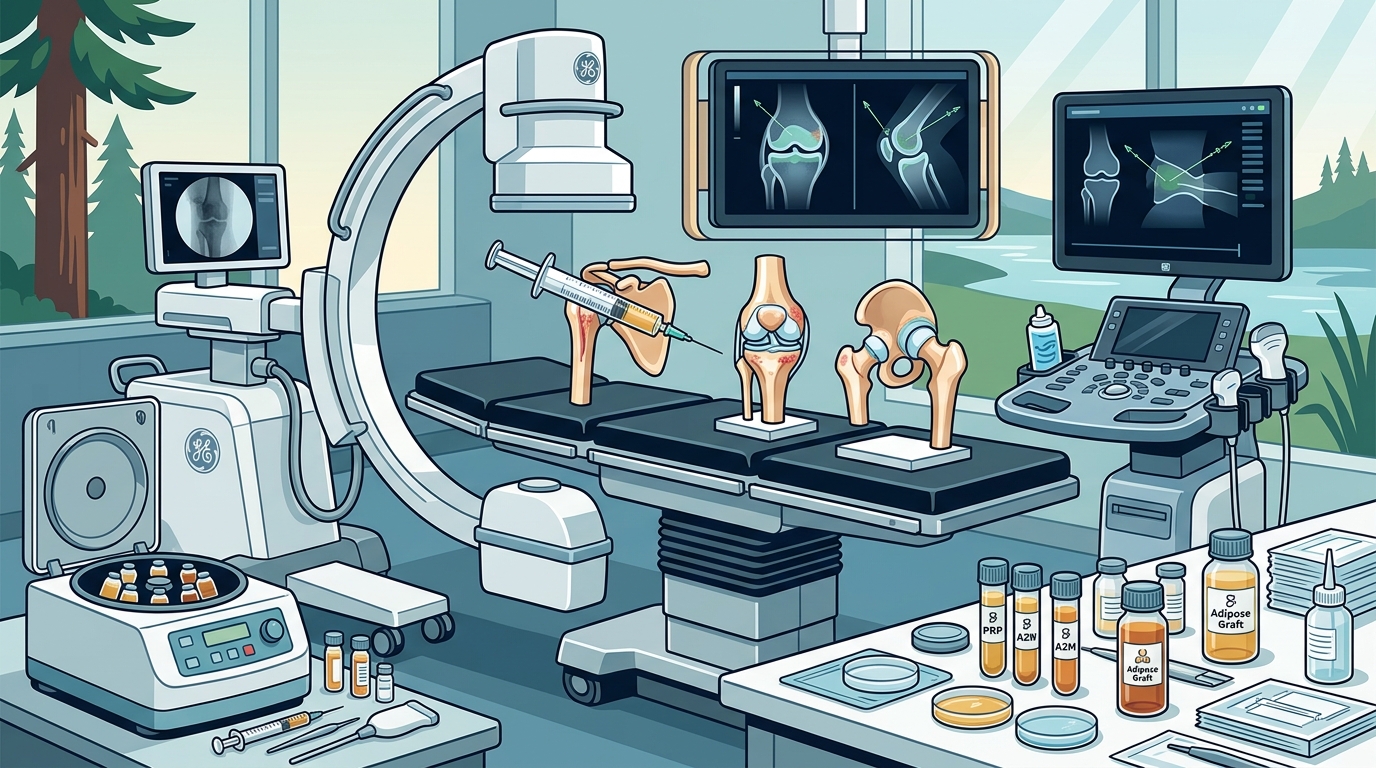
For deeper joints or certain spinal procedures, fluoroscopy provides live X-ray imaging to help confirm bony landmarks and needle position. Oregon Regenerative Medicine reports having four Sonosite ultrasound systems and a GE OEC One Flat Panel C-Arm system for image-guided procedures. Its page describing ultrasound expertise in regenerative medicine explains the practice’s emphasis on precision-guided care.
Image guidance does not guarantee a successful outcome, but it can help the clinician target the intended structure and avoid nearby nerves or blood vessels. It also supports more precise diagnosis when a small amount of anesthetic is used to determine whether a particular structure is contributing to pain.
How common options compare
| Option | May be considered for | What patients should know | Recovery considerations |
|---|---|---|---|
| PRP therapy | Selected tendon injuries and mild-to-moderate osteoarthritis | Uses a preparation made from the patient’s blood; research results vary by joint and protocol | Temporary soreness is possible; activity is often modified briefly |
| Prolotherapy | Selected ligament laxity, chronic sprain, and instability patterns | Intended to stimulate a local healing response; diagnosis and treatment selection are important | Short-term tenderness or swelling may occur; improvement may develop gradually |
| Autologous adipose tissue therapies | Selected degenerative or soft-tissue conditions after individualized evaluation | Processing, regulatory status, evidence, and realistic goals should be discussed in detail | Includes recovery considerations related to tissue collection and injection |
| A2M injections | Selected degenerative joint conditions | Designed to address enzymes associated with tissue breakdown; evidence and candidacy should be reviewed | Often involves limited downtime, but physician-specific instructions apply |
| Joint replacement consultation | Advanced arthritis, severe deformity, persistent disability, or failure of appropriate conservative care | May provide substantial relief when the joint is severely damaged; it is a major operation with rehabilitation and surgical risks | Recovery is longer and requires structured postoperative rehabilitation |
Can regenerative medicine eliminate the need for joint replacement?
Sometimes a non-surgical plan can reduce pain enough that surgery is no longer the immediate priority. In other cases, it may provide a period of improved function while the patient prepares for surgery. However, no injection can reliably reverse every case of advanced arthritis.
Joint replacement may remain appropriate when pain is severe and persistent, imaging shows extensive joint destruction, deformity limits movement, walking or daily activities are substantially impaired, or appropriately supervised non-surgical care has not helped. A regenerative medicine physician should be willing to recommend an orthopedic surgical opinion when the likely benefits of replacement outweigh the risks of continuing conservative treatment.
The most useful question is not “Can this doctor guarantee that I will avoid surgery?” It is “Can this doctor give me an accurate diagnosis, explain my options honestly, and help me make a safe decision based on my goals?”
Key takeaways
- The doctor to seek is a physician with advanced experience in regenerative, interventional, sports, physical medicine, pain, orthopedic, or integrative musculoskeletal care.
- A complete evaluation should identify the painful structure, assess the stage of degeneration, review imaging, and account for the patient’s goals and overall health.
- PRP, prolotherapy, adipose tissue therapies, A2M injections, rehabilitation, and integrative care may be considered for selected patients.
- PRP research is most developed for knee osteoarthritis, but results vary and treatment should not be presented as a guaranteed cure. ([pubmed.ncbi.nlm.nih.gov](https://pubmed.ncbi.nlm.nih.gov/40653151/?utm_source=openai))
- FDA approval and regulatory status matter. Many products broadly marketed as “stem cell” or regenerative therapies are not FDA-approved for orthopedic conditions. ([fda.gov](https://www.fda.gov/vaccines-blood-biologics/consumers-biologics/important-patient-and-consumer-information-about-regenerative-medicine-therapies?utm_source=openai))
- Ultrasound and fluoroscopy can improve procedural targeting, particularly in deep or anatomically complex areas.
- Joint replacement may still be the best option for some patients with end-stage arthritis or major functional loss.
- Early evaluation may give patients more choices than waiting until pain and joint damage are advanced.
Frequently asked questions
What doctor should I see for shoulder, knee, or hip pain if I want to avoid replacement?
Consider a physician experienced in regenerative and interventional musculoskeletal medicine. Depending on the practice, this may be a sports medicine, physical medicine, pain medicine, naturopathic, integrative, or orthopedic physician with advanced training in image-guided procedures and joint-preservation care.
Does PRP work for knee osteoarthritis?
PRP may reduce pain and improve function for some people with knee osteoarthritis, but the evidence is mixed and outcomes vary by disease severity, preparation, injection protocol, and patient characteristics. Recent reviews have reported benefits at selected follow-up periods while also noting limitations and heterogeneity. ([pubmed.ncbi.nlm.nih.gov](https://pubmed.ncbi.nlm.nih.gov/40653151/?utm_source=openai))
How quickly does PRP begin to work?
Some patients notice improvement within several weeks, while others improve more gradually over a few months. Temporary soreness after an injection can occur. Your physician should provide condition-specific expectations rather than guarantee a particular timeline.
Are stem cell injections FDA-approved for arthritis?
The FDA states that regenerative medicine therapies, including stem-cell products, have not been approved for treating orthopedic conditions such as osteoarthritis, hip pain, knee pain, or shoulder pain. Patients should ask exactly what product is being offered, how it is processed, what evidence supports it, and whether it is administered under an appropriately regulated clinical trial. ([fda.gov](https://www.fda.gov/vaccines-blood-biologics/consumers-biologics/important-patient-and-consumer-information-about-regenerative-medicine-therapies?utm_source=openai))
Can severe arthritis be treated without joint replacement?
Some patients with severe arthritis may obtain meaningful symptom relief or delay surgery, but end-stage arthritis, major deformity, or profound disability may still make replacement the most appropriate option. A qualified physician should discuss both non-surgical and surgical pathways.
Is ultrasound guidance better than a landmark-based injection?
Ultrasound allows the clinician to see relevant soft tissues and the needle in real time, which can improve targeting and help avoid nearby structures. It does not guarantee treatment success, but it can be valuable for complex or deep anatomy.
What happens at the first consultation?
The physician typically reviews your history, performs a physical examination, evaluates existing imaging, determines whether additional imaging is needed, and discusses treatment choices, expected recovery, risks, costs, and alternatives.
What side effects can occur with regenerative injections?
Possible effects include temporary pain, swelling, bruising, stiffness, or soreness at the injection or tissue-collection site. Infection, bleeding, nerve or vessel injury, and lack of benefit are less common but important risks to discuss. Autologous treatment does not eliminate every procedural risk.
Discuss your options with Oregon Regenerative Medicine
If shoulder, knee, or hip pain is limiting your life, an evaluation can help clarify whether the source is arthritis, tendon or ligament injury, instability, referred pain, or another condition. Oregon Regenerative Medicine has served patients in Oregon since 1978 and provides regenerative and integrative care in the Portland and Lake Oswego area, including image-guided PRP, prolotherapy, adipose tissue graft therapies, and related services.
To learn whether a joint-preservation approach may be appropriate for you, visit the Contact Page or call (503) 636-2734. The purpose of a consultation is not to promise that surgery will never be necessary; it is to help you understand your diagnosis and make an informed treatment decision.