

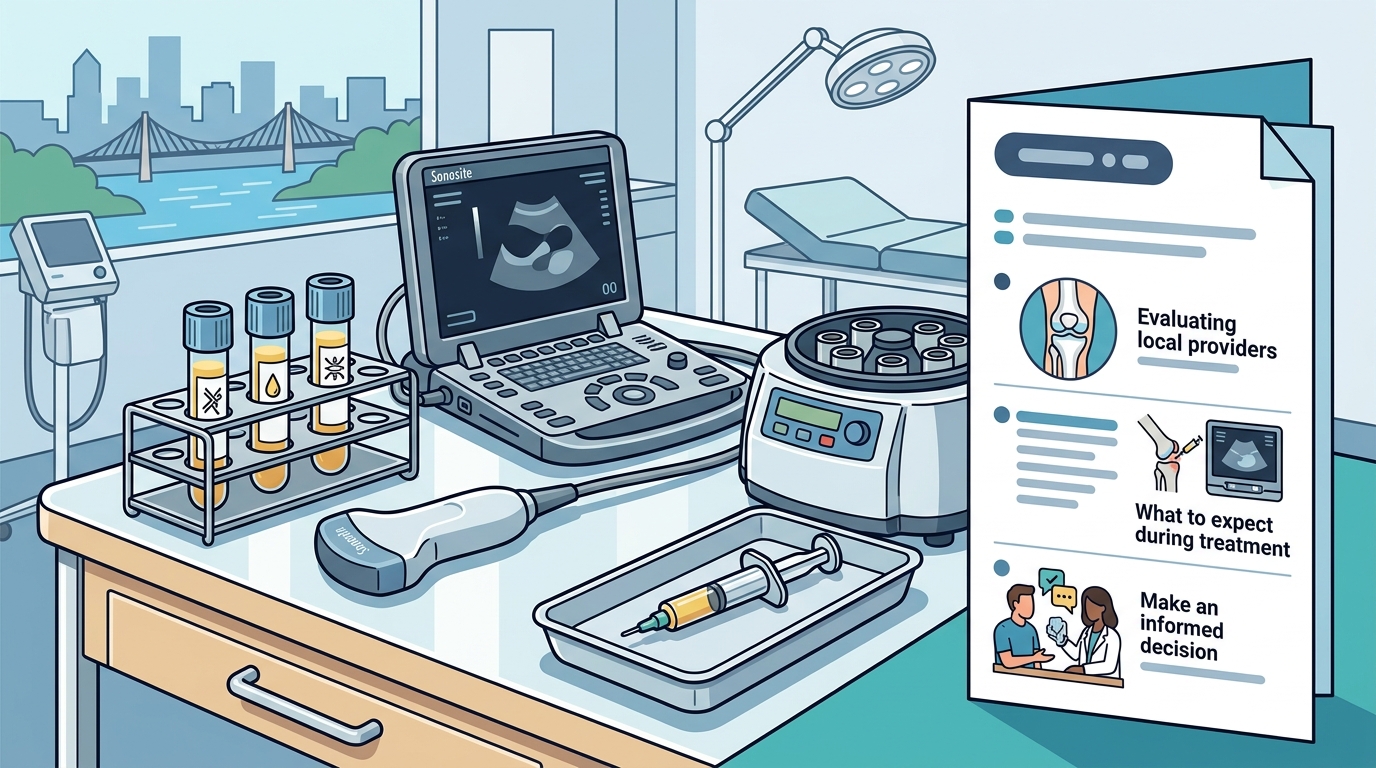
For patients seeking PRP injections for joint pain in Portland, Oregon Regenerative Medicine offers a specialized, non-surgical approach using in-house prepared platelet-rich plasma and advanced imaging guidance. This ultimate guide explains how to evaluate local providers, what to expect during treatment, and how to make an informed decision for your specific joint condition.
How to Choose a Provider
Selecting the right provider for PRP therapy requires looking beyond marketing claims to examine clinical infrastructure and diagnostic capabilities. A high-quality practice should prioritize precision and evidence-based protocols over high-volume, low-cost models. The most critical differentiator is the use of advanced imaging technology to guide the injection.
Imaging and Precision
At Oregon Regenerative Medicine, we utilize four Sonosite ultrasound systems and a state-of-the-art GE OEC One Flat Panel C-Arm fluoroscopy system. This combination allows our physicians to visualize both soft tissue and bony anatomy in real time. For deep joints like the spine or sacroiliac joints, fluoroscopy is the gold standard for ensuring the biologic agent reaches the exact target area.
In-House Laboratory Preparation
The quality of the PRP itself is determined by how it is prepared. We prepare PRP, PRF, and platelet lysates in our in-house laboratory. This ensures that the platelet concentration is optimized for your specific condition and that the product is used immediately after preparation, maximizing its biological potency.
Questions to Ask Before Committing
Before scheduling an appointment, you should ask potential providers specific questions about their methodology. These questions will reveal whether the provider is using a standardized, low-effort approach or a tailored, high-precision protocol.
- How is the PRP prepared? Ask if they use an in-house lab or a third-party kit. In-house preparation often allows for more control over platelet concentration.
- What imaging is used? Confirm if they use ultrasound or fluoroscopy. For peripheral joints, ultrasound is standard; for spine, fluoroscopy is preferred.
- What is the platelet concentration? Different conditions require different concentrations. A provider who adjusts the concentration based on your diagnosis is likely more experienced. according to PRP Injections for
Verifying Credentials and Claims
Regenerative medicine is a rapidly evolving field, and not all practitioners have the same level of training. You can verify a provider's credentials by checking their board certifications and specific training in orthobiologics. At Oregon Regenerative Medicine, our team includes Dr. Noel Peterson, ND, DAAPM, and Dr. Kristian Flores, MD, ND, who bring diverse expertise to the practice.
Look for providers who are transparent about their training and who can explain the science behind their specific protocols. If a provider cannot explain why they use a specific type of PRP or imaging modality, it may be a red flag.
The Treatment Process
PRP therapy is a non-surgical procedure that uses your own blood to promote healing. The process typically involves three main steps: blood draw, processing, and injection.
Step 1: Blood Draw
A small sample of your blood is drawn from your arm. This is similar to a standard blood test and is usually quick and minimally invasive.
Step 2: Processing
The blood is placed in a centrifuge to separate the platelets from the other blood components. This creates a concentrated solution of platelets rich in growth factors. At Oregon Regenerative Medicine, this is done in our in-house laboratory to ensure quality control.
Step 3: Injection
The concentrated PRP is injected into the affected joint or tissue. This is done under imaging guidance to ensure accuracy. The procedure itself is usually quick, and most patients can return to normal activities the next day.
Understanding Costs
The cost of PRP therapy varies based on several factors, including the type of joint being treated, the complexity of the procedure, and the provider's fees. Generally, PRP is more expensive than a standard corticosteroid injection but less expensive than surgery. according to Platelet Rich Plasma
| Factor | Impact on Cost |
|---|---|
| Joint Type | Spine and deep joints may cost more due to the need for fluoroscopy. |
| Imaging Used | Fluoroscopy-guided procedures typically have higher facility fees than ultrasound-guided ones. |
| Number of Injections | Some conditions may require multiple sessions, which increases the total cost. |
It is important to ask for a detailed cost estimate before treatment. Insurance coverage for regenerative medicine is limited, so most patients pay out-of-pocket. according to PRP Injections for
Common Mistakes to Avoid
Patients often make mistakes that can reduce the effectiveness of their PRP treatment. The most common mistake is not following post-procedure instructions. You should avoid anti-inflammatory medications like NSAIDs for a period after the injection, as they can inhibit the healing process.
Another mistake is expecting immediate results. PRP works by stimulating your body's natural healing response, which takes time. Most patients notice improvement over several weeks, not immediately.
PRP vs. Other Alternatives
PRP is one of several options for treating joint pain. Understanding how it compares to other treatments can help you make a better decision.
PRP vs. Corticosteroids
Corticosteroids provide quick pain relief but do not promote healing. PRP, on the other hand, aims to repair tissue. While steroids may be better for acute inflammation, PRP is often preferred for chronic degenerative conditions.
PRP vs. Surgery
Surgery is a more invasive option with a longer recovery time. PRP is a non-surgical alternative that may help you avoid surgery or delay it. However, not everyone is a candidate for PRP, and severe cases may still require surgical intervention.
PRP for Specific Joint Conditions
The effectiveness of PRP can vary depending on the specific joint and condition being treated. At Oregon Regenerative Medicine, we treat a wide range of conditions, including knee osteoarthritis, shoulder arthritis, and chronic back pain.
For knee osteoarthritis, PRP has shown promise in reducing pain and improving function. For shoulder arthritis, we are currently conducting a clinical study exploring the use of PRP combined with A2M Protein Concentrate. This highlights the ongoing research into optimizing biologic therapies for different conditions. according to Platelet Rich Plasma
Regulatory Rules and Patient Protections
Regenerative medicine is regulated by the FDA and state medical boards. It is important to ensure that your provider is following all regulatory guidelines. At Oregon Regenerative Medicine, we use adult stem cells and PRP that are harvested from your own body, which are approved by the FDA for research and treatment of a wide variety of conditions.
Patients have the right to informed consent. Your provider should explain the risks, benefits, and alternatives to PRP therapy before you agree to treatment. They should also provide you with a clear understanding of what to expect and how to care for yourself after the procedure.
Local Specifics in Portland and Lake Oswego
Portland and the surrounding Willamette Valley offer a variety of options for regenerative medicine. Oregon Regenerative Medicine is located in Lake Oswego, Oregon, on the Willamette River. Our practice has been serving the community since 1978, bringing decades of experience to our regenerative protocols.
When choosing a local provider, consider their location and convenience. Oregon Regenerative Medicine is easily accessible from Portland and other parts of the Willamette Valley. We offer a comprehensive range of services, including PRP, prolotherapy, and stem cell therapies, all under one roof.
Timing Your Treatment
The timing of your PRP treatment can impact its effectiveness. It is generally best to start PRP therapy before your condition becomes too severe. Early intervention can help preserve joint function and prevent further degeneration.
However, if you are currently experiencing acute inflammation, your provider may recommend waiting until the inflammation subsides before starting PRP. This ensures that the growth factors in the PRP can work effectively.
Long-Term Results and Expectations
PRP therapy is not a one-time fix. It is a process that works with your body's natural healing mechanisms. Most patients notice gradual improvement over several weeks to months. The goal is to achieve durable, pain-free function without the need for surgery or long-term pain medications.
At Oregon Regenerative Medicine, the vast majority of our patients have been able to achieve drug-free, pain-free function without surgery or joint replacement. While no treatment has a 100% success rate, PRP offers a promising option for many patients with chronic joint pain.
Key Takeaways
- Choose a provider that uses advanced imaging like ultrasound or fluoroscopy for precision.
- Ask about the PRP preparation process and platelet concentration.
- Verify the provider's credentials and training in orthobiologics.
- Understand the costs involved, as insurance coverage is limited.
- Follow post-procedure instructions, including avoiding NSAIDs.
- Expect gradual improvement over weeks to months, not immediate relief.
- Consider PRP as a non-surgical alternative to delay or avoid surgery.
- Early intervention can help preserve joint function.
Frequently Asked Questions
Is PRP therapy covered by insurance?
Most insurance plans do not cover PRP therapy, as it is considered an experimental or elective treatment. You will likely need to pay out-of-pocket.
How long does a PRP injection take?
The entire process, including blood draw, processing, and injection, usually takes about 30 to 60 minutes.
Does PRP hurt?
The injection itself may cause some discomfort, but most patients tolerate it well. Your provider may use a local anesthetic to minimize pain.
How many PRP injections will I need?
The number of injections depends on your specific condition and response to treatment. Some patients may need only one, while others may benefit from multiple sessions.
Can I return to work after PRP?
Most patients can return to normal activities the next day. However, you should avoid strenuous activity for a few days.
Is PRP safe?
PRP is generally considered safe because it uses your own blood. The main risks are minor, such as bruising or temporary pain at the injection site.