Oregon Regenerative Medicine offers stem cell therapy for knees in Portland and Lake Oswego, Oregon. This guide covers micro-fragmented adipose tissue (M-FAT) injections, platelet-rich plasma (PRP) therapy, and prolotherapy. We explain how these regenerative options work, who qualifies, and how to choose the right treatment for your specific knee condition.
M-FAT Injections for Knee Repair
Micro-fragmented adipose tissue (M-FAT) is a regenerative therapy that uses small pieces of the patient's own fat tissue to support joint healing. At Oregon Regenerative Medicine, we utilize adipose-derived stem cells and signaling factors to address knee osteoarthritis and cartilage wear. This approach is distinct from traditional stem cell isolates because it preserves the extracellular matrix and a diverse population of regenerative cells.
The Role of Adipose Tissue
Adipose tissue is the most abundant source of adult stem cells in the human body. Unlike embryonic stem cells, adult adipose cells are well-researched and approved for various therapeutic applications. When processed into M-FAT, the tissue provides a biological scaffold that can help reduce inflammation and promote tissue repair in the knee joint.
Candidate Selection
Not every patient with knee pain is a candidate for M-FAT therapy. We evaluate the severity of joint damage, the patient's overall health, and specific imaging results. This therapy is often considered for patients with moderate to advanced osteoarthritis who wish to delay or avoid joint replacement surgery. The procedure involves harvesting a small sample of fat, processing it in-house, and injecting it into the knee.
PRP Therapy for Knee Pain
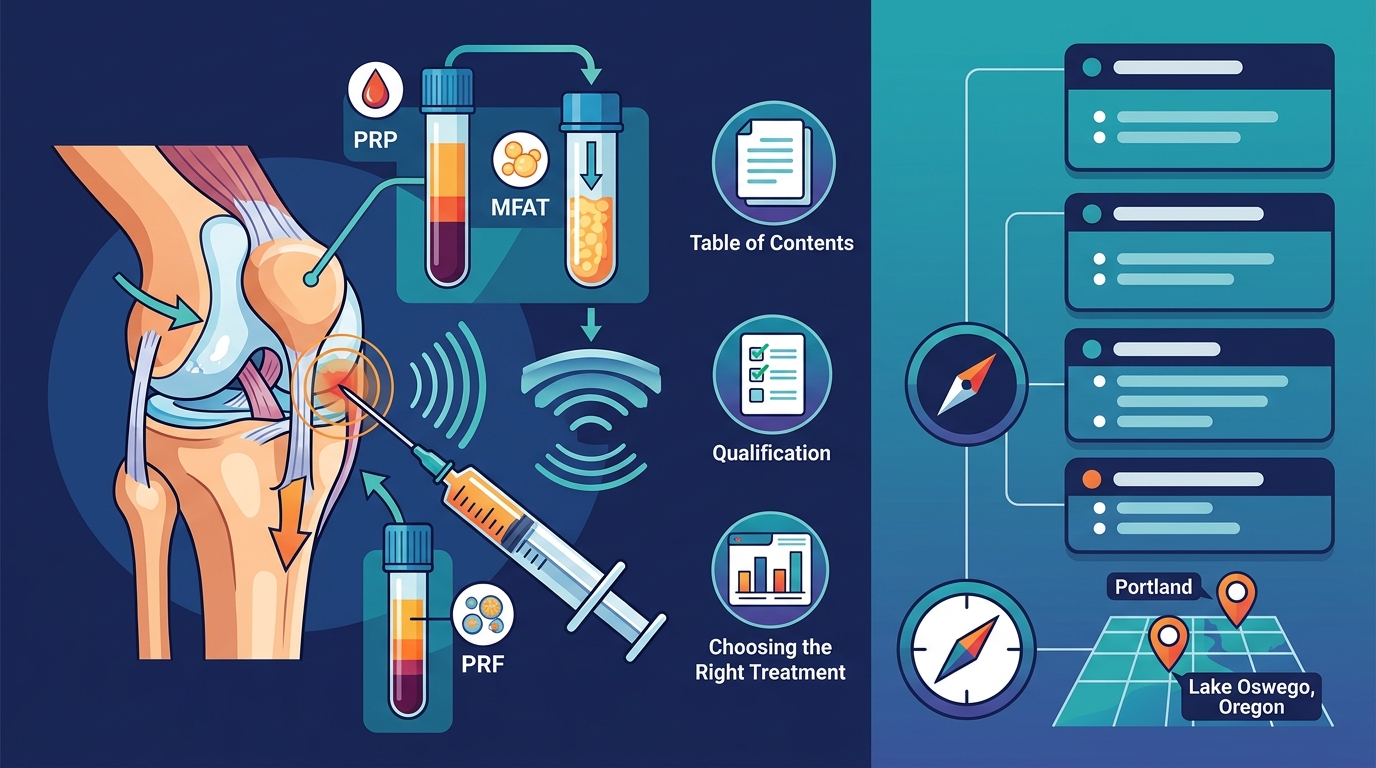
Platelet-rich plasma (PRP) is a concentrated solution of platelets derived from the patient's own blood. Platelets contain growth factors that help calm inflammation and support tissue repair. During PRP therapy, this concentrated solution is injected into the knee joint or surrounding injured tissue. It is a non-steroidal, non-surgical option designed to support the body's natural repair response.
How PRP Works in the Knee
PRP is recommended for knee osteoarthritis, chronic tendon irritation, and soft tissue injuries that have not improved with rest or physical therapy. The growth factors in PRP stimulate the body's healing cascade, which can lead to more durable improvement than corticosteroid injections for selected patients. We use in-house laboratory preparation to ensure high-quality PRP for each patient.
Ultrasound-Guided Precision
Accuracy is critical for successful outcomes. Our physicians use ultrasound-guided injections to ensure the PRP reaches the exact site of injury. This precision improves treatment outcomes and reduces procedural risk. Ultrasound imaging is equal to or better than MRI in evaluating most tendon and ligament disorders, allowing for real-time diagnosis and treatment in a single visit.
Prolotherapy for Joint Stability
Prolotherapy is a non-surgical injection procedure that stimulates the body's wound repair cascade. It is used to heal joints, tendons, and ligaments when other treatments fail. By restarting the body's innate repair mechanisms, prolotherapy can result in the permanent repair of damaged connective tissue. This therapy is particularly effective for ligament laxity and joint instability.
Combining Prolotherapy with Other Therapies
Depending on the specific injury, the addition of PRP or stem cell therapy can add powerful regenerative healing properties to prolotherapy. This combined approach addresses both the structural instability and the inflammatory components of knee pain. Our team tailors the protocol to each patient's diagnosis and goals, ensuring a comprehensive treatment plan.
Treatment Comparison Table
| Therapy | Primary Mechanism | Best For | Recovery Time |
|---|---|---|---|
| M-FAT Injections | Adipose-derived stem cells and extracellular matrix | Cartilage wear, moderate to advanced osteoarthritis | Variable, depends on severity |
| PRP Therapy | Growth factors from concentrated platelets | Tendon irritation, mild to moderate osteoarthritis | Swift, patients can remain active |
| Prolotherapy | Wound repair cascade stimulation | Ligament laxity, joint instability | Variable, depends on protocol |
Key Takeaways
- Oregon Regenerative Medicine offers M-FAT, PRP, and prolotherapy for knee conditions in the Portland area.
- M-FAT uses the patient's own fat tissue to provide stem cells and signaling factors for joint repair.
- PRP is a non-steroidal option that uses growth factors to calm inflammation and support tissue repair.
- Prolotherapy stimulates the body's innate repair mechanisms to heal damaged connective tissue.
- Ultrasound-guided injections ensure precision and improve treatment outcomes.
- Candidate selection depends on the severity of joint damage and overall health.
- Combining therapies may provide more comprehensive results for complex knee injuries.
- Our team provides a whole-person approach, addressing the condition from multiple angles.
Frequently Asked Questions
Who offers stem cell therapy for knees in Portland Oregon?
Oregon Regenerative Medicine offers stem cell therapy for knees in Portland and Lake Oswego, Oregon. We use adipose-derived stem cells and M-FAT injections to support joint healing.
Is M-FAT the same as stem cell therapy?
M-FAT is a form of regenerative therapy that uses micro-fragments of adipose tissue. It contains stem cells and other regenerative components, making it a biocellular approach to joint repair.
How does PRP help with knee pain?
PRP contains growth factors that help calm inflammation and support tissue repair. It is a non-steroidal option that can provide more durable improvement than corticosteroid injections for selected patients.
What is prolotherapy used for in the knee?
Prolotherapy is used to heal joints, tendons, and ligaments by stimulating the body's wound repair cascade. It is particularly effective for ligament laxity and joint instability.
Do you use ultrasound for knee injections?
Yes, our physicians use ultrasound-guided injections to ensure precision. This improves treatment outcomes and reduces procedural risk by ensuring the therapy reaches the exact site of injury.
Can I remain active during treatment?
Patients can often remain active during the treatment process. Recovery time is swift, and our whole-person approach promotes optimal health during the healing process.
Conclusion
Choosing the right regenerative therapy for your knee depends on your specific diagnosis and goals. Oregon Regenerative Medicine provides a comprehensive approach to knee pain, offering M-FAT, PRP, and prolotherapy in a state-of-the-art facility. Our team of experienced physicians uses advanced imaging and in-house laboratory preparation to deliver precise, evidence-informed care. If you are seeking non-surgical options for knee osteoarthritis or injury, we invite you to schedule a consultation to discuss your treatment plan.