
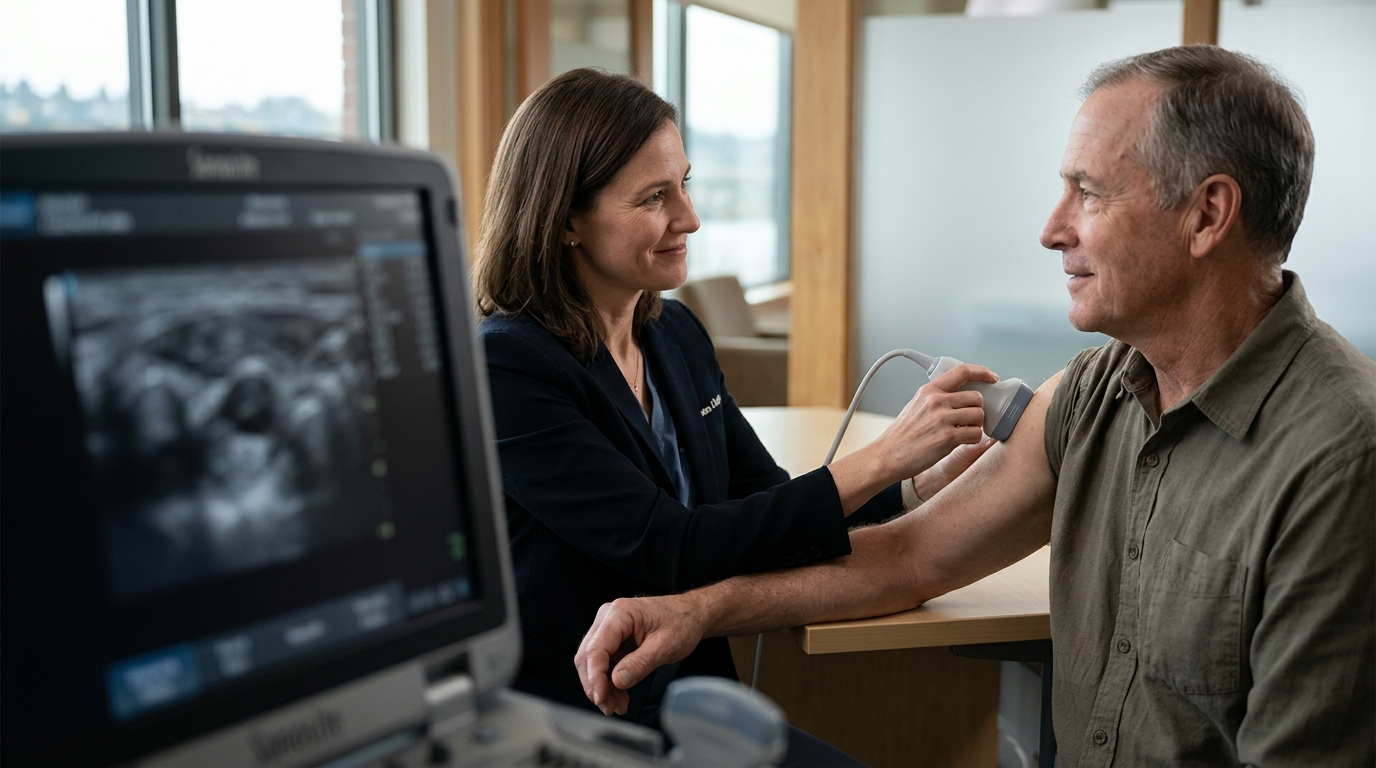
Platelet-rich plasma (PRP) therapy is a non-surgical regenerative treatment that uses a patient's own blood to stimulate healing in damaged shoulder tissues. At Oregon Regenerative Medicine, we utilize advanced imaging and in-house laboratory preparation to deliver precise, evidence-based care for shoulder osteoarthritis. This process moves beyond simple pain masking to address the underlying biological causes of joint degeneration.
1. Comprehensive Clinical Evaluation and Imaging
Accurate diagnosis is the foundation of successful regenerative treatment. Before any injection is considered, a physician must confirm that the pain source is indeed the shoulder joint and not a referred pain from the neck or a specific tendon tear. At Oregon Regenerative Medicine, we utilize in-office ultrasound and fluoroscopy to visualize the joint space and surrounding soft tissues in real time. This diagnostic step ensures that the treatment plan targets the exact area of inflammation and degeneration.
2. Blood Draw and Sample Preparation
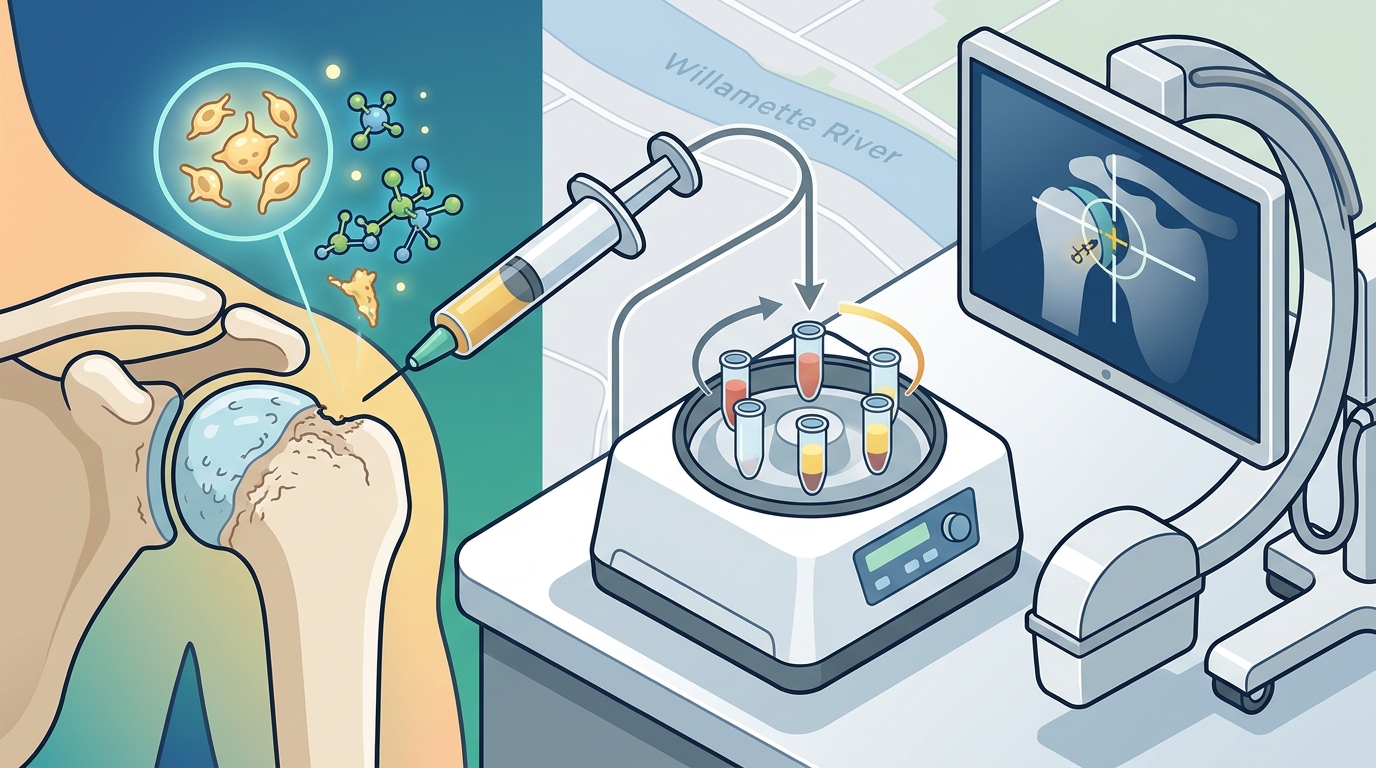
PRP is created from the patient's own blood, ensuring a biocompatible treatment. A small sample of blood is drawn from the patient's arm and placed into a specialized centrifuge. This process separates the blood into its components, concentrating the platelets in a small volume of plasma. Because the material is autologous, meaning it comes from the patient's own body, the risk of allergic reaction or rejection is virtually nonexistent.
3. Laboratory Optimization of Growth Factors
Proper activation is required to release the healing proteins within the platelets. Once the platelets are concentrated, the sample is activated to trigger the release of growth factors and cytokines. These biological agents are the primary drivers of the healing response. Oregon Regenerative Medicine prepares these biologics in-house, allowing for precise control over the concentration and activation of the platelet-rich plasma before it is administered.
4. Image-Guided Needle Placement
Precision is critical when injecting into the complex anatomy of the shoulder. The shoulder joint is a ball-and-socket structure with limited space and many surrounding nerves and tendons. Using fluoroscopy or ultrasound guidance, the physician can see the needle tip in real time as it enters the joint capsule. This level of accuracy is far superior to landmark-based injections, ensuring the PRP is delivered exactly where the cartilage and synovium are damaged.
5. Intra-articular Injection of PRP
The concentrated plasma is injected directly into the joint space to initiate repair. Once the needle is confirmed to be in the correct position, the PRP is slowly injected into the shoulder joint. The goal is to coat the damaged cartilage and synovial lining with the growth factors. This creates a localized environment that is rich in the proteins necessary for tissue remodeling and inflammation reduction.
6. Biological Activation of the Healing Cascade
PRP works by restarting the body's natural wound healing process. After injection, the growth factors bind to receptors on the cells within the joint. This stimulates the production of new collagen and the migration of stem cells to the site of injury. In cases of shoulder arthritis, this process helps to reduce the inflammatory markers that cause pain and stiffness, while potentially slowing the progression of cartilage loss.
7. Post-Procedure Monitoring and Rehabilitation
Healing is a process that requires appropriate activity management. Patients are typically advised to avoid heavy lifting or high-impact activities for a short period after the injection. The physician will monitor the patient's progress through follow-up appointments to assess pain levels and range of motion. In many cases, PRP is combined with physical therapy to ensure that the joint regains full strength and stability as the biological healing takes place.
Choosing the Right Approach for Your Shoulder
Frequently Asked Questions
How many PRP injections are needed for shoulder arthritis?
Most patients receive a single injection for shoulder osteoarthritis, though some may benefit from a second treatment if the initial response is partial. The physician will evaluate your progress at follow-up visits to determine if additional treatments are necessary.
Does PRP injection hurt?
The procedure is generally well-tolerated. A local anesthetic is often used to numb the area before the injection. Most patients report only mild discomfort or a feeling of pressure during the procedure, which subsides quickly.
How long does it take for PRP to work?
While some patients may feel a reduction in pain within a few days, the full biological effects of PRP typically develop over 4 to 12 weeks. The healing process is gradual as the growth factors stimulate tissue repair.
Is PRP better than corticosteroid injections?
PRP and corticosteroids serve different purposes. Steroids provide rapid but temporary pain relief by suppressing inflammation, while PRP aims to promote long-term tissue healing. Many studies suggest that PRP may provide more durable results for certain types of shoulder pain compared to steroids.
Who is a good candidate for PRP therapy?
Good candidates are those with mild to moderate shoulder arthritis or tendinopathy who wish to avoid surgery. Patients with severe joint destruction or active infection may not be suitable candidates for regenerative injections.
Can I return to work after a PRP injection?
Most patients can return to light-duty work the day after the procedure. However, those with physically demanding jobs may need to take a few days off to allow the initial inflammation to settle.
Next Steps for Your Shoulder Health
If you are struggling with shoulder arthritis and looking for a non-surgical solution, the team at Oregon Regenerative Medicine is here to help. We combine advanced regenerative therapies with a whole-person approach to ensure you achieve the best possible outcome. To schedule a consultation and learn more about how PRP therapy can help you, please contact our office today.