
Common Mistakes Patients Make When Pursuing Joint Preservation Without Surgery
Joint preservation has emerged as a critical alternative to total joint replacement for thousands of patients suffering from osteoarthritis and chronic musculoskeletal injuries. Recent clinical data indicates that regenerative medicine interventions, such as Platelet Rich Plasma (PRP) and stem cell therapies, can significantly delay or eliminate the need for surgical intervention in many cases. However, the path to durable pain-free function is rarely linear. Many patients inadvertently undermine their own healing potential by falling into common behavioral and medical traps. Understanding these pitfalls is essential for anyone seeking to restore mobility and longevity without invasive procedures. (PRP amp Biocellular Joint)
The Speed Fallacy: Expecting Immediate Results
One of the most pervasive mistakes patients make is expecting joint preservation therapies to work like a painkiller. When you take an anti-inflammatory medication, the relief is often immediate. Regenerative medicine operates on a completely different biological timeline. Platelet Rich Plasma is a concentrated source of growth factors that stimulate the body's natural healing response. This process requires time for cellular recruitment, proliferation, and tissue remodeling. (Joint preservation techniques)
Patients often discontinue their treatment plan after the first session because they do not feel a dramatic difference within days. This is a critical error. The healing cascade for tendons, ligaments, and cartilage typically takes weeks to months to manifest clinically. According to research on the efficacy of Platelet-Rich Plasma in treating knee osteoarthritis, significant improvements in pain and function are often observed over a period of several months rather than days. Rushing the process or expecting instant gratification leads to premature abandonment of effective therapies.
Furthermore, the inflammatory phase of healing is necessary for regeneration. Some patients mistake post-injection soreness for failure or injury. In reality, this localized inflammatory response is the body's signal that the healing process has been successfully initiated. Patience and adherence to the prescribed timeline are non-negotiable for success.
Ignoring Image-Guided Precision
Not all injections are created equal. A common mistake is seeking treatment from providers who rely solely on anatomical landmarks or "blind" injections. Without real-time visualization, there is a high risk of missing the target tissue entirely. This is particularly dangerous in complex joints like the hip or spine, where surrounding nerves and blood vessels must be avoided.
Ultrasound imaging is equal to or better than MRI in evaluating most tendon and ligament disorders. By using ultrasound guidance, physicians can see the needle tip in real-time as it enters the tissue. This ensures that the therapeutic agents are delivered exactly where they are needed, whether it is the synovial lining of a joint, the substance of a torn tendon, or the periosteum of a bone.
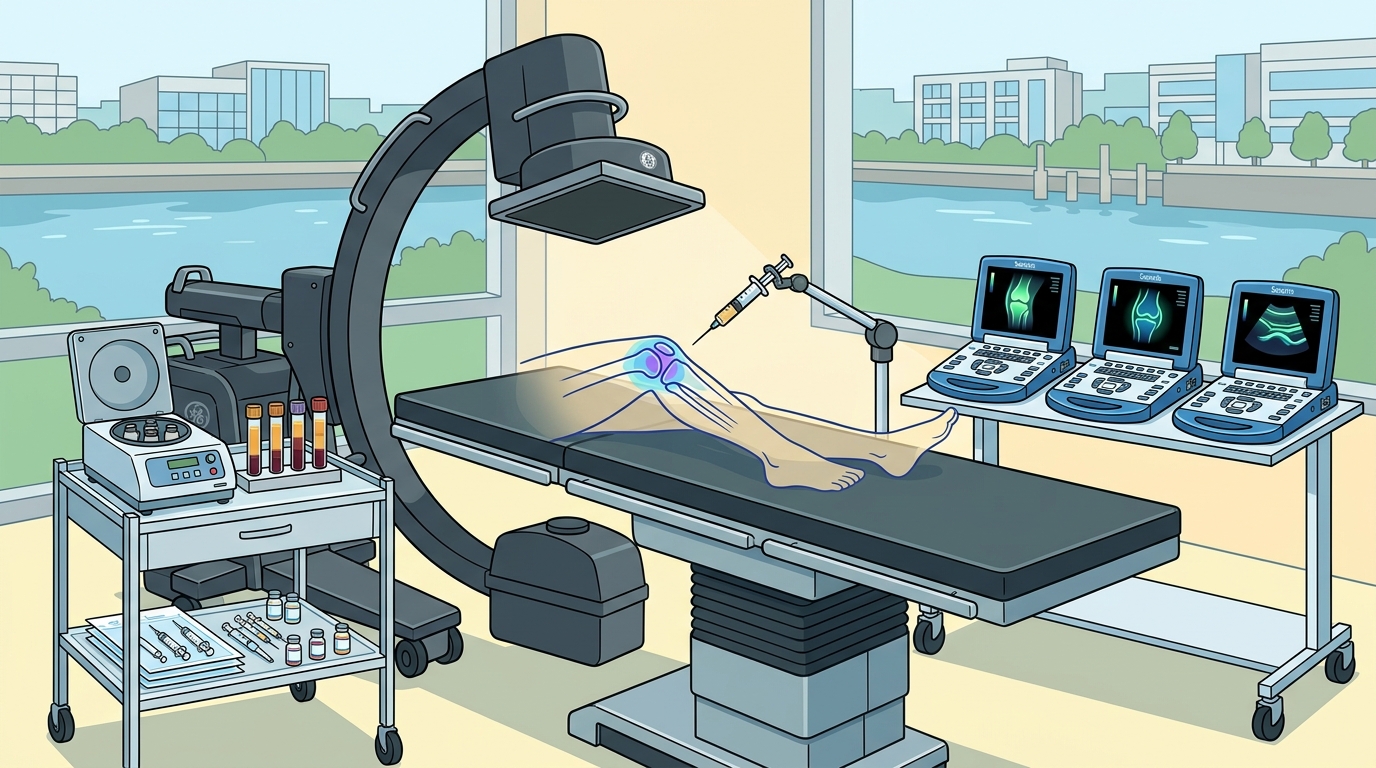
At Oregon Regenerative Medicine, we utilize both ultrasound imaging and fluoroscopic C-Arm guidance for our non-surgical injection procedures. This level of precision maximizes the efficacy of every milliliter of PRP or stem cell graft. Patients who seek out providers without this technological capability are essentially gambling with their treatment outcomes. The difference between a blind injection and an image-guided one can be the difference between recovery and continued degeneration.
Assuming One-Size-Fits-All Treatments
Another significant error is the assumption that a single modality will solve every joint problem. Some patients insist on PRP for a condition that requires stem cells, or vice versa. While both are powerful tools in regenerative medicine, they serve different biological functions.
PRP is primarily a signaling molecule. It releases cytokines and growth factors that tell the body to heal. It is excellent for mild to moderate degeneration and soft tissue injuries. On the other hand, autologous Adipose Tissue Stem Cell Grafts provide reparative cells that can differentiate into various tissue types. For advanced osteoarthritis where cartilage loss is significant, the cellular component of adipose-derived stem cells may offer a more robust regenerative potential than PRP alone.
| Treatment Modality | Primary Mechanism | Ideal Candidate Profile | Key Benefit |
|---|---|---|---|
| Platelet Rich Plasma (PRP) | Growth Factor Signaling | Mild to moderate degeneration, soft tissue injuries | Stimulates natural repair cycles without adding cells |
| Adipose Stem Cell Therapy | Cellular Regeneration | Advanced osteoarthritis, significant tissue loss | Provides reparative cells for structural restoration |
| Prolotherapy | Inflammatory Stimulation | Ligamentous laxity, chronic instability | Strengthens connective tissue through controlled irritation |
Choosing the wrong tool for the job is a wasted opportunity. A thorough diagnostic evaluation, often involving ultrasound, is required to determine which modality or combination of therapies will yield the best outcome for your specific pathology.
Neglecting the Holistic Ecosystem
Patients often view joint preservation as a purely mechanical issue. They focus entirely on the injection and ignore the systemic factors that drive inflammation and degeneration. This is a fundamental misunderstanding of how the body heals. Regenerative Orthopedic Medicine is a powerful healing art and medical specialty that requires a holistic approach.
Diet, sleep, stress management, and hormonal balance all play critical roles in tissue repair. If a patient is consuming a pro-inflammatory diet high in processed sugars and trans fats, they are actively fighting against the healing signals sent by their PRP or stem cell therapy. Similarly, chronic stress elevates cortisol levels, which can inhibit tissue regeneration and exacerbate pain perception.
At Oregon Regenerative Medicine, we integrate condition-specific nutritional programs and hormone optimization into our treatment plans. We address the root causes of degeneration, not just the symptoms. Patients who neglect these lifestyle factors are like gardeners planting seeds in toxic soil. No matter how good the seed (the therapy) is, the environment (the body) must be conducive to growth.
Delaying Intervention Until It Is Too Late
Perhaps the most costly mistake is waiting until the joint is "bad enough" to require surgery. Many patients endure years of pain, relying on painkillers and corticosteroid injections, which can actually accelerate cartilage degradation over time. By the time they seek regenerative care, the structural damage may be too extensive for biological repair.
Regenerative medicine is most effective in the early to mid-stages of degeneration. Once the joint space is completely obliterated and bone-on-bone contact is severe, the biological potential for regeneration is significantly diminished. Early intervention preserves the remaining cartilage and stabilizes the joint environment. As noted in studies on the regeneration of cartilage in human knee osteoarthritis, autologous adipose tissue-derived stem cells can facilitate significant structural improvements when applied before end-stage disease.
Do not wait for the "perfect" time to act. The best time to pursue joint preservation is when the diagnosis is made, not when the pain becomes unbearable. Early action preserves options and improves long-term outcomes.
Key Takeaways
- Patience is Critical: Regenerative therapies work on a biological timeline of weeks to months, not days. Expecting immediate results leads to premature discontinuation of treatment.
- Precision Matters: Image-guided injections using ultrasound or fluoroscopy ensure therapeutic agents are delivered to the exact site of pathology, maximizing efficacy and safety.
- Tailored Approaches: PRP, stem cells, and prolotherapy serve different functions. Treatment must be matched to the specific stage and type of joint degeneration.
- Holistic Integration: Joint preservation requires addressing systemic inflammation through nutrition, hormonal balance, and lifestyle changes alongside medical interventions.
- Early Intervention: Regenerative medicine is most effective before end-stage osteoarthritis sets in. Delaying care reduces the potential for biological repair.
- Provider Expertise: Seek providers with decades of experience in regenerative medicine, such as the team at Oregon Regenerative Medicine, who have performed over 40,000 regenerative injections.
- Realistic Expectations: While no treatment has 100% success, the vast majority of patients achieve durable pain-free function without surgery when following a comprehensive plan.
Frequently Asked Questions
How long does it take for PRP therapy to work for joint pain?
PRP therapy typically requires several weeks to months to show full clinical benefits. The initial inflammatory response occurs within the first few days, followed by a proliferation phase where new tissue begins to form. Significant pain reduction and functional improvement are often observed between 6 to 12 weeks post-treatment, with continued improvement up to six months.
Is ultrasound guidance necessary for joint injections?
Ultrasound guidance is highly recommended for joint and soft tissue injections. It allows the physician to visualize the needle tip in real-time, ensuring accurate placement of the therapeutic agent into the target tissue while avoiding nerves and blood vessels. This precision significantly enhances the safety and efficacy of the treatment compared to blind injections.
What is the difference between PRP and stem cell therapy for joints?
PRP (Platelet Rich Plasma) is a concentrate of your own platelets that release growth factors to stimulate healing. It is ideal for mild to moderate degeneration. Stem cell therapy, specifically adipose-derived stem cells, involves harvesting reparative cells from your own fat tissue. These cells can differentiate into various tissue types and are often used for more advanced degeneration or significant tissue loss.
Can regenerative medicine reverse osteoarthritis?
Regenerative medicine aims to halt the progression of osteoarthritis and promote tissue repair, potentially reversing some structural damage. While it may not completely "cure" end-stage arthritis, it can significantly reduce pain, improve function, and delay or eliminate the need for joint replacement surgery in many patients.
What are the risks of stem cell therapy for joints?
When using autologous (your own) adipose-derived stem cells, the risk of immune rejection or disease transmission is virtually non-existent. The primary risks are associated with the injection procedure itself, such as temporary soreness, swelling, or rare infection. It is crucial to seek treatment from qualified medical professionals who follow strict sterile protocols.
How many PRP treatments are usually needed?
The number of treatments varies based on the severity of the condition. Some patients experience significant relief after a single injection, while others may benefit from a series of 2 to 3 treatments spaced several weeks apart. Your provider will recommend a protocol based on your specific diagnosis and response to initial therapy.
Is Prolotherapy effective for joint instability?
Yes, Prolotherapy is highly effective for joint instability caused by ligamentous laxity. It works by injecting an irritant solution, such as dextrose, into the ligament to stimulate a localized inflammatory healing response. This process strengthens and tightens the ligament, providing greater joint stability and reducing pain.
Schedule Your Consultation
Do not let common mistakes compromise your joint health. If you are suffering from osteoarthritis, chronic pain, or a sports injury, it is time to take a proactive approach to joint preservation. Oregon Regenerative Medicine offers evidence-based, image-guided regenerative therapies tailored to your unique needs. Our team of experienced physicians is dedicated to helping you achieve pain-free function and active longevity.
Contact us today to schedule your consultation and learn how regenerative medicine can help you avoid surgery and reclaim your life.