
Regenerative medicine has transformed the landscape of orthopedic care, offering hope to millions suffering from chronic joint pain. However, the rapid growth of this field has also fueled a proliferation of misinformation. According to recent clinical analyses, patient hesitation often stems from a lack of clear, evidence-based education regarding Platelet-Rich Plasma (PRP) and stem cell therapies. At Oregon Regenerative Medicine, we have performed over 40,000 regenerative injections, providing a vast dataset that confirms the efficacy of these non-surgical treatments for thousands of patients in the Pacific Northwest. This guide dismantles the most persistent myths surrounding these therapies, clarifying what the science actually says about healing your joints naturally.
Myth 1: Stem Cells Are Only From Embryos
One of the most pervasive myths in regenerative medicine is the assumption that all stem cell therapies involve embryonic tissue. This misconception often causes unnecessary anxiety for patients who are ethically opposed to such sources. The reality is that modern orthopedic regenerative medicine primarily utilizes autologous adult stem cells. Autologous stem cells are harvested from the patient's own body, typically from adipose tissue or bone marrow, ensuring zero risk of immune rejection or ethical conflict.
At Oregon Regenerative Medicine, we specialize in Adipose Biocellular therapies. This process involves harvesting a small amount of fat tissue, processing it to isolate the stromal vascular fraction, and reinjecting it into the damaged joint. This approach leverages the body's natural healing mechanisms without introducing foreign biological material. For a deeper understanding of the biological differences, you can review research on adipose-derived stem cells compared to other sources.
Myth 2: PRP Is Just a Placebo Effect
Critics often dismiss Platelet-Rich Plasma (PRP) as a mere placebo, arguing that the improvement patients feel is psychological rather than physiological. This view ignores decades of peer-reviewed research demonstrating the biochemical activity of platelets. PRP is not just blood; it is a concentrated solution of platelets that release growth factors and cytokines. These compounds stimulate tissue repair, reduce inflammation, and promote angiogenesis (the formation of new blood vessels).
Scientific literature supports the efficacy of PRP for conditions like knee osteoarthritis and tendon injuries. A meta-analysis of randomized controlled trials published in major orthopedic journals confirms that PRP injections provide significant pain relief and functional improvement compared to saline injections. For detailed clinical evidence, see the efficacy of PRP in knee osteoarthritis research. The biological response is measurable and reproducible, not imagined.
Myth 3: Results Are Immediate and Guaranteed
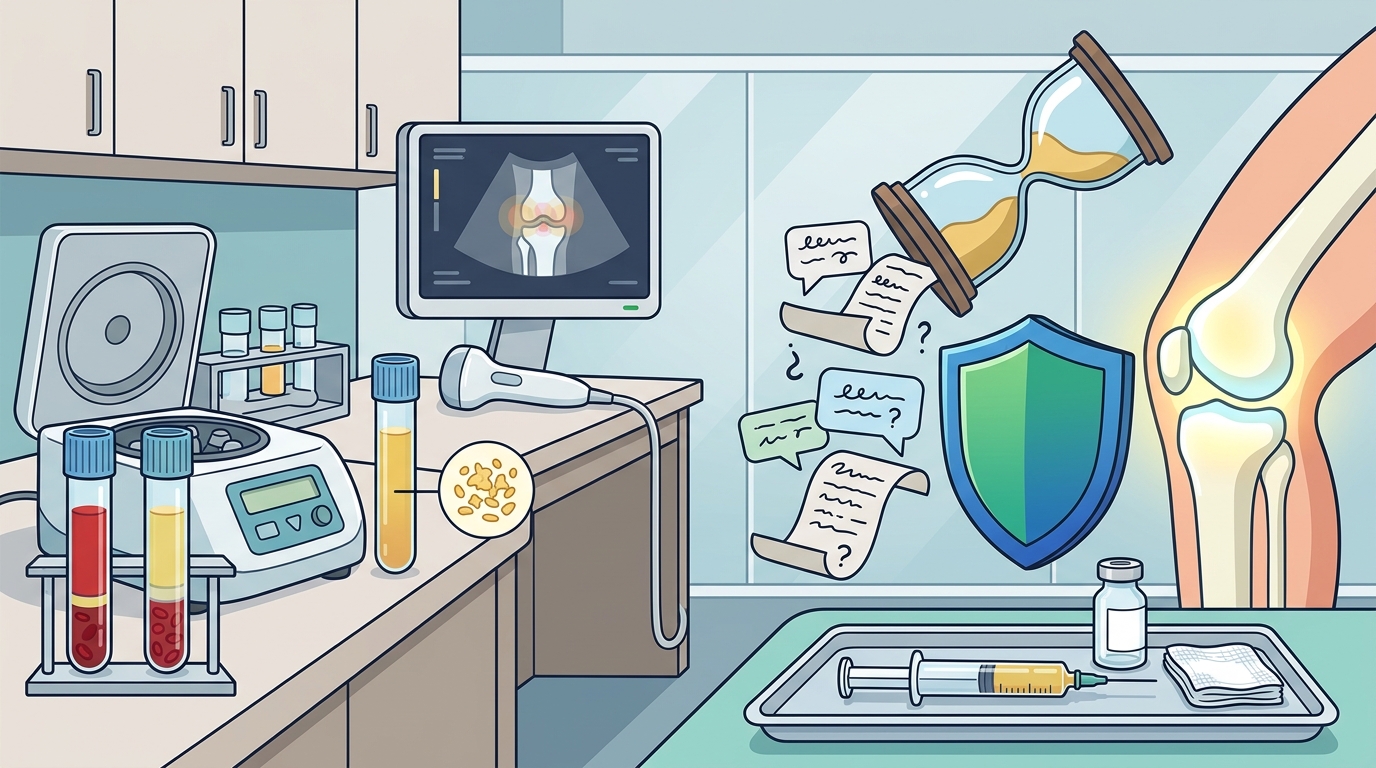
Patients often enter consultations expecting instant pain relief, similar to taking a painkiller. This is a dangerous misconception. Regenerative medicine works by stimulating the body's natural healing cascade, a process that takes time. Healing is a biological timeline, not an on-off switch. Most patients begin to notice improvements within 4 to 6 weeks, with continued progress for up to 6 months as the tissue remodels.
While no treatment has a 100% success rate, the vast majority of our patients at Oregon Regenerative Medicine achieve durable pain-free function. Understanding the timeline is crucial for setting realistic expectations. If you are considering this path, reviewing our patient articles can provide valuable insights into the typical recovery journey and what to expect during the inflammatory phase of healing.
Myth 4: Ultrasound Guidance Is Unnecessary
A critical distinction between high-quality regenerative care and generic "cocktail" clinics is the use of imaging guidance. Some providers rely solely on anatomical landmarks, guessing where to place the needle. This approach is outdated and risky. Ultrasound imaging is equal to or better than MRI for evaluating most tendon and ligament disorders in real-time. It allows the physician to see the needle tip as it enters the tissue, ensuring the regenerative material is delivered exactly to the site of injury.
At Oregon Regenerative Medicine, all physicians are highly skilled in ultrasound imaging. This expertise allows us to separate individual tendon fibers, avoid nerves, and treat the precise pathology. For more information on why this precision matters, read our guide on ultrasound expertise in joint regeneration. Without this guidance, you risk missing the target entirely, rendering the expensive treatment ineffective.
Myth 5: These Treatments Are Only for Elite Athletes
Regenerative medicine is often marketed toward professional athletes seeking to return to play quickly. While athletes do benefit significantly, these therapies are equally vital for the aging population. Osteoarthritis affects millions of older adults, often leading to a cycle of pain, inactivity, and further joint degeneration. PRP and stem cell therapies offer a way to break this cycle by repairing the underlying damage rather than just masking the symptoms.
Our patient base includes thousands of individuals from Oregon and Washington who have been told their only option is surgery or lifelong pain medication. By choosing regenerative options, they reclaim their independence. For those interested in the broader scope of our work, including clinical studies on shoulder repair, we provide comprehensive care for all ages and activity levels.
Therapy Comparison: PRP vs. Stem Cells
Understanding the differences between these two primary modalities is essential for making an informed decision. Both are autologous, but they serve different biological roles.
| Feature | Platelet-Rich Plasma (PRP) | Adipose Stem Cell Therapy |
|---|---|---|
| Source | Patient's own blood | Patient's own fat tissue |
| Primary Mechanism | Growth factor release | Cellular regeneration and paracrine signaling |
| Best For | Tendonitis, mild-moderate arthritis | Severe arthritis, large tissue defects |
| Recovery Time | Shorter, less invasive | Slightly longer due to harvest site |
| Cost | Generally lower | Generally higher due to processing |
Key Takeaways
- Autologous Safety: Modern stem cell therapies use the patient's own adult cells, eliminating ethical concerns and rejection risks.
- Biological Reality: PRP is a concentrated biological agent, not a placebo, supported by extensive meta-analyses.
- Patient Volume: Oregon Regenerative Medicine has performed over 40,000 injections, validating the safety and efficacy of these protocols.
- Imaging Precision: Ultrasound guidance is non-negotiable for accurate delivery and optimal clinical outcomes.
- Timeline: Healing takes months, not days; patience is a critical component of the treatment plan.
- Accessibility: These treatments are for anyone with degenerative joint disease, not just elite athletes.
- Local Expertise: As a home-grown Pacific Northwest expert, ORM provides region-specific care for Oregon and Washington residents.
Frequently Asked Questions
Is PRP therapy painful?
Most patients report mild discomfort during the injection, which is managed with local anesthesia. The post-injection inflammatory phase may cause soreness for a few days, but this is a sign of the healing process beginning.
How many stem cell injections do I need?
Typically, one to three injections are sufficient for most orthopedic conditions. The exact number depends on the severity of the degeneration and the body's individual response to the therapy.
Are stem cell treatments covered by insurance?
Currently, most insurance plans consider regenerative medicine experimental or cosmetic for orthopedic use. However, the cost is often significantly lower than surgery and offers a higher quality of life. We recommend checking with your provider for specific coverage details.
What is the difference between PRP and Prolotherapy?
PRP uses concentrated platelets to release growth factors, while Prolotherapy uses an irritant solution (like dextrose) to stimulate healing. Both are effective, but PRP is often preferred for its biological potency and reduced post-treatment pain.
Can I drive after the procedure?
If you receive local anesthesia only, you can usually drive yourself home. If sedation is used, you will need a ride. Our team will provide specific instructions based on your treatment plan.
How long do the results last?
Results can last from one to several years, depending on the patient's activity level, age, and the extent of the initial damage. Many patients find that the treatment slows the progression of arthritis significantly.
Is ultrasound guidance always used?
Yes, at Oregon Regenerative Medicine, we use ultrasound or fluoroscopic guidance for all joint injections to ensure precision and safety. This is a standard of care that distinguishes us from less rigorous clinics.
Schedule Your Consultation
Stop letting myths dictate your health decisions. If you are suffering from joint pain, osteoarthritis, or chronic injury, regenerative medicine may be the solution you have been seeking. Our team of experienced physicians is ready to evaluate your condition and create a personalized treatment plan. Contact us today to learn more about how we can help you live a pain-free life. Visit our contact page to schedule your appointment at our Portland clinic.